Gold Lot Size Calculator
 By
Staff Writer
By
Staff Writer

Gold Lot Size Calculator
Enter your risk and stop loss to get your exact XAU/USD position size.
Contract sizes vary between brokers and account types. Always confirm the contract specification in your platform before placing a trade. This tool is for information only and is not investment advice.
Work out your exact gold lot size using the calculator above, then read on for how the calculation works, what each position size costs you per dollar of movement, and what to check with your broker before you place the trade.
Lot size is the single biggest lever on your risk when trading gold. Get it wrong and a normal day’s volatility can take a chunk out of your account that you never intended to expose.
What is Lot Size in Gold Trading?
In gold trading, lot size refers to the quantity of gold CFDs being bought or sold in a transaction. A lot is a standardised unit of measurement that tells you how much gold you are actually trading, usually expressed in troy ounces.
Gold CFDs are typically traded in the following lot sizes:
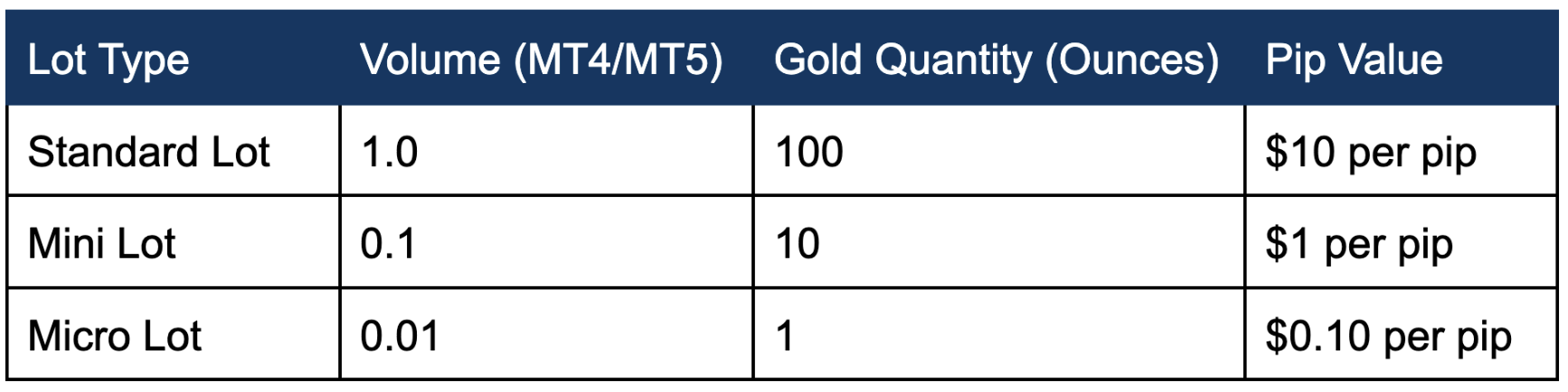
These lot sizes exist for one reason: to let you control exactly how much risk exposure you take on each trade.
Why is Lot Size Important in Gold Trading?
The lot size you choose has a direct impact on your potential profit or loss on every trade.
- Standard Lot (1.0) = 100 ounces of gold
- Mini Lot (0.1) = 10 ounces of gold
- Micro Lot (0.01) = 1 ounce of gold
If the price of gold moves by $1:
- A Standard Lot changes your balance by $100
- A Mini Lot changes your balance by $10
- A Micro Lot changes your balance by $1
Gold routinely moves $20 to $40 in a single session. On a standard lot, that is a $2,000 to $4,000 swing. The right lot size is the one that keeps that swing inside what your account can absorb.
How to Calculate Lot Size for Gold Trading
The calculation runs in two steps. First work out how many ounces of gold you can afford to trade, then convert that into lots.
Gold Lot Size Formula:
Ounces to trade = Risk Amount ÷ Stop Loss Distance (in dollars per ounce)
Lot Size = Ounces ÷ Contract Size (usually 100)
Here it is with real numbers. Say you want to risk $100 on a gold trade, and your stop loss sits $20 per ounce away from your entry.
Ounces to trade = $100 ÷ $20 = 5 ounces
Lot Size = 5 ÷ 100 = 0.05 lots
So you would enter 0.05 into the volume field on your platform. If gold moves $20 against you, you lose exactly the $100 you set out to risk, and no more.
Always round down, never up. Rounding 0.067 up to 0.07 means you are risking more than you decided to. The calculator at the top of this page does that for you automatically.
What is 0.01 lot size in gold?
A 0.01 lot size in gold is the smallest position most brokers will let you open. On a standard 100-ounce contract, 0.01 lots equals exactly 1 ounce of gold. Every $1 move in the gold price changes your balance by $1, and every pip ($0.01 of movement) is worth about $0.10.
This is the size most new traders should start with. If gold is trading at $2,400 an ounce, a 0.01 lot position controls roughly $2,400 of gold, and a $20 adverse move costs you $20. Use the calculator above to check what 0.01 lots means against your own stop loss before you place the trade.
What is 0.05 lot size in gold?
A 0.05 lot size in gold equals 5 ounces on a standard 100-ounce contract. Every $1 move in the gold price is worth $5 to your account, and each pip is worth roughly $0.50.
This tends to be the sweet spot for traders risking around $100 with a stop loss of about $20 per ounce, which is exactly the worked example above. It is small enough to survive gold’s volatility but large enough that a winning trade is worth having.
What is 0.1 lot size in gold?
A 0.1 lot size in gold, sometimes called a mini lot, equals 10 ounces on a standard contract. Every $1 move in gold is worth $10, and each pip is worth about $1.
At this size, a $10 adverse move in the gold price costs you $100. Given that gold can move $20 to $40 in a session, 0.1 lots is only appropriate if your account can absorb a few hundred dollars of drawdown without breaching your risk rules.
What is a standard lot size in gold?
A standard lot size in gold is 1.0 lots, which represents 100 ounces on most brokers’ XAU/USD contracts. Every $1 move in the gold price is worth $100 to your account, and every pip is worth around $10.
One standard lot in gold is a large position. With gold near $2,400 an ounce, 1.0 lots controls roughly $240,000 of exposure. A $10 move against you, which gold can produce in minutes, costs $1,000. Standard lots are for well-capitalised accounts with strict risk controls, not for testing a strategy.
Contract sizes are not identical across every broker. Some list gold in 10-ounce contracts, and symbol names vary (XAUUSD, GOLD, XAUUSD.m). Confirm the contract specification in your own platform before you size a trade.
Gold Lot Sizes and Pip Values
Lot size and pip value are two sides of the same coin. Here is what each pip movement is worth at each size.
- Standard Lot (1.0): $10 per pip
- Mini Lot (0.1): $1 per pip
- Micro Lot (0.01): $0.10 per pip
Note that gold does not move in pips the way currency pairs do. Traders generally think in dollars per ounce instead, which is why the calculator above asks for your stop loss in dollars rather than pips.
Gold Lot Sizes Compared Across Brokers
Contract specifications differ between brokers. Here is how gold lot sizes compare across two commonly used platforms:
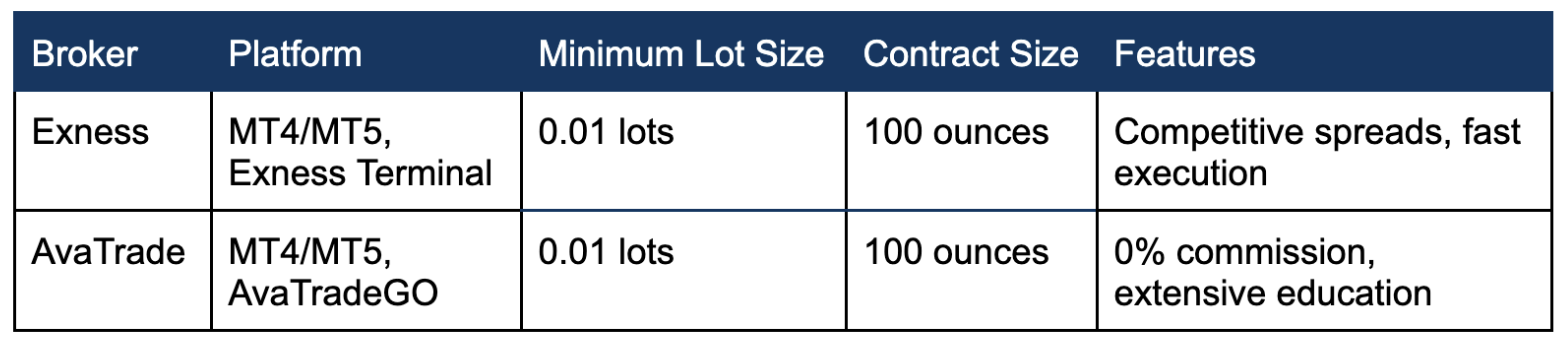
The takeaway is not which broker to use. It is that you cannot assume 1.0 lots means 100 ounces everywhere. Check the specification on your own platform before you size a trade.
Does leverage affect your gold lot size?
No. Your lot size comes from two numbers only: how much you’re risking and how far away your stop loss sits. If you’re risking $100 with a $20 per ounce stop, the answer is 0.05 lots whether your leverage is 1:30 or 1:500.
What leverage decides is something else entirely: whether you have enough margin in the account to open that position. At 1:100 leverage with gold near $2,400, one standard lot (100 ounces, so $240,000 of exposure) requires roughly $2,400 of margin. At 1:500, the same position needs about $480.
That is a separate check, and it should come after you’ve worked out your lot size, not before. Sizing a trade based on the maximum position your leverage allows is the fastest way to lose an account. Size from your stop, then confirm you have the margin to hold it.
How to Check Gold Contract Specs on MT4 and MT5
Before you size any gold trade, confirm what one lot actually represents on your platform. On MetaTrader 4 or MetaTrader 5:
1. Right-click the gold symbol (XAUUSD) in the Market Watch window.
2. Select Specification to view contract size, minimum volume, and volume step.
The contract size for gold is usually 100 ounces per 1.0 lot, but this is not guaranteed. Some brokers and some account types use different contract sizes, and the minimum volume step can vary too. Check it once, and the calculator above will do the rest.
Using a Gold Trading Calculator
If maths isn’t your strongest subject, the gold lot size calculator at the top of this page does the whole thing for you. Enter what you’re risking, your stop loss distance in dollars per ounce, and your broker’s contract size, and it returns the exact lot size to enter, rounded down so you never exceed your intended risk.
It also shows you what each $1 move in gold is worth at that position size, which is the number most traders forget to check before they click buy.
Tips for Managing Lot Size in Gold Trading
Start small. If you are new to gold, micro lots let you learn how the instrument behaves without putting real money at risk.
Size from your stop, not your gut. Decide your stop loss first, then let the maths tell you the lot size. Doing it the other way round is how accounts get blown up.
Give gold room to breathe. Tight stops on a volatile instrument get taken out by noise. A wider stop with a smaller lot size will survive where a tight stop with a large lot size will not.
Final Thoughts
Calculating the right lot size is the most important risk decision you make on a gold trade, and it takes about ten seconds once you know the formula. Risk amount divided by stop loss distance gives you ounces. Ounces divided by contract size gives you lots. Round down.
Familiarise yourself with your broker’s contract specifications, understand what each position size costs you per dollar of movement, and size every trade deliberately rather than by feel.
Share this article!


Recent News
How to Compare Trading Platforms When You Are Based in the Gulf: Costs, Regulation and Access to UK and US Markets

How to check your credit score in the UAE

How Many Free Zones in Dubai? and Why It Barely Matters

Featured
No reviews found.
No reviews found.



No reviews found.
No reviews found.