Will Silver Prices Go Up? What the 2026 Data Shows
 By
Sam Reid
By
Sam Reid

Whether silver prices go up from here is the wrong question to ask in isolation, because silver has already made an extraordinary move. It surged well over 100% in 2025 and pushed to record highs above 120 dollars an ounce in early 2026 before correcting hard. The honest question now is not whether silver can rise, since it clearly can, but whether the structural forces behind that rally are strong enough to drive it higher again after such a sharp run and pullback.
This guide lays out what the current data shows: the supply deficit that underpins the bull case, the demand picture, what analysts are forecasting, and the real risks. The short version is that the long-term case is intact, but silver is volatile enough that timing and expectations matter as much as direction.
The Structural Story: A Sixth Straight Supply Deficit
The single most important fact behind silver’s strength is a persistent gap between supply and demand. According to The Silver Institute and its research partner Metals Focus, 2026 is set to be the sixth consecutive year of structural deficit, with the shortfall projected at roughly 46 million ounces.
That deficit is not a one-off. As reported by TheStreet, citing Reuters and Bloomberg data, more than 760 million ounces have been drawn from global stockpiles since 2021 to cover the gap, and the 2026 deficit is projected to widen from the previous year even as total demand softens. When above-ground stocks keep shrinking, the market becomes more sensitive to any surge in buying.
Why supply cannot simply catch up
One detail makes the deficit so durable, and most casual coverage misses it. Around 70% of silver is produced as a byproduct of mining other metals, such as copper, gold, lead, and zinc. That means silver output is largely determined by demand for those other metals, not by the silver price. Even when silver rises sharply, miners cannot easily produce more of it, because they are not mining it as the main target in the first place. Supply is structurally slow to respond, which is exactly what keeps a deficit persistent.
The Demand Side: Industry Versus Investment
Silver is unusual because it is both an industrial metal and a store of value, and those two roles pull on the price in different ways.
On the industrial side, silver is essential to solar panels, electronics, electric vehicles, and increasingly to AI-related hardware. This demand has been a major driver of the deficit. It is not unlimited, though. When prices spiked, some solar manufacturers began thrifting and substituting silver to protect their margins, and industrial fabrication is forecast to dip in 2026 from its recent peak. High prices can suppress the very demand that drove them.
On the investment side, silver behaves like a safe-haven asset alongside gold, and coin and bar demand is expected to rise in 2026 on renewed buying. Investment flows are more sentiment-driven and can swing quickly, which is part of why silver is more volatile than gold.
What Analysts Are Forecasting
Forecasts for 2026 span an unusually wide range, and that spread tells you more than any single number. After silver blew past most institutions’ earlier targets, many were revised upward, but analysts remain divided on where it settles.
| Source | 2026 view |
|---|---|
| Reuters analyst poll (median) | Around $79.50/oz |
| J.P. Morgan | Roughly $81/oz average |
| ING | Around $78/oz average |
| Citigroup | Up to $110 in the second half |
| Bank of America | A wide scenario range, with bullish cases well above $100 |
The takeaway is not to fixate on one target. As several analysts have noted, the signal worth watching is the direction of revisions through the year. Upgrades from major banks are a bullish sign; downgrades are a genuine headwind. A range this wide is really the market admitting that the outcome depends on factors nobody can predict with confidence.
The Factors That Will Decide It
Several forces will determine whether silver climbs from here, and they interact in ways that make the metal hard to call.
Federal Reserve policy and the dollar
Silver is priced in dollars and pays no yield, so it tends to strengthen when interest rates fall and the dollar weakens, and to struggle when rates stay high. Expectations around Fed rate cuts have been one of the strongest short-term drivers, and any shift in that outlook moves the price. This is also a source of uncertainty, since forecasts for Fed policy in 2026 are themselves divided.
The gold-silver ratio
The gold-silver ratio measures how many ounces of silver equal one ounce of gold. Historically it has compressed during precious-metal bull markets, and silver has tended to outperform gold in those periods. With the ratio still elevated by historical standards, some analysts argue there is room for silver to catch up, though a ratio staying wide would suggest the opposite.
Industrial and economic health
Because so much silver demand is industrial, the metal is sensitive to global growth. A strong economy with expanding solar and technology sectors supports demand, while a slowdown, or high prices triggering substitution, works against it.
The Risks
The bull case is well supported, but silver is not a one-way bet, and the early-2026 correction proved it.
Silver is markedly more volatile than gold, and it can fall as fast as it rises. Anyone buying after a large run faces the risk of a sharp pullback, which is exactly what happened to those who bought near the January 2026 peak. High prices can also erode industrial demand as manufacturers substitute the metal, weakening one of the pillars of the deficit. And if the Fed keeps rates higher for longer, or the dollar stays strong, that removes a major tailwind. Forecasts in this market are revised quickly and often, so treat any target, bullish or bearish, as a snapshot rather than a promise.
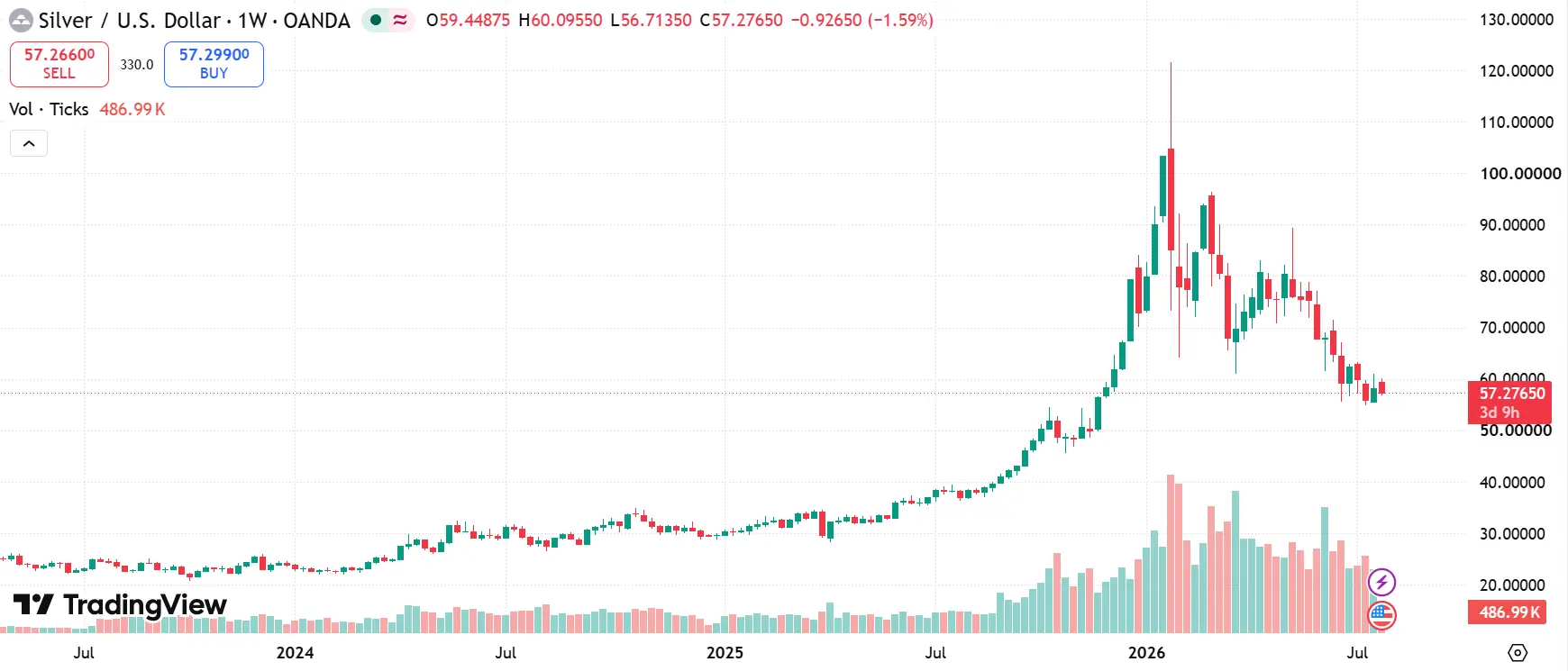
Silver price chart (2025-2026)
So, Will Silver Prices Go Up?
The structural case points upward over the longer term. A sixth year of supply deficit, a physical shortage that mining cannot quickly fix, and durable demand from solar, electronics, and AI all support higher prices over time, which is why most analysts remain bullish on a multi-year view.
The near term is far less certain. Silver has already delivered an enormous rally and a sharp correction within a single year, and the analyst range for 2026 is wide enough to contain both strong gains and further weakness. For anyone considering it, the sensible reading is that silver has a genuine long-term tailwind but demands a tolerance for volatility, a long time horizon, and no expectation of a smooth ride. It is a position to size carefully, not a certainty to chase.
Frequently Asked Questions
Will silver prices go up in 2026?
Analysts are broadly bullish over the long term, supported by a sixth consecutive supply deficit and strong industrial demand, but the near-term picture is uncertain. Silver already surged in 2025 and hit record highs in early 2026 before correcting, and 2026 forecasts range widely from around $78 to well above $100, reflecting genuine disagreement about the path ahead.
Why is silver in a supply deficit?
Demand from industry and investment has outpaced supply for several years, and supply is slow to respond because around 70% of silver is mined as a byproduct of other metals. That means output does not rise much even when the silver price does, keeping the deficit structurally persistent.
What drives the silver price?
The main factors are industrial demand (solar, electronics, electric vehicles, and AI hardware), Federal Reserve interest-rate policy, the strength of the US dollar, investment and safe-haven demand, and the gold-silver ratio. Silver’s dual role as both an industrial metal and a store of value makes it more volatile than gold.
Is silver more volatile than gold?
Yes. Silver’s smaller market and its heavy industrial exposure make it react more sharply to economic cycles and sentiment. It tends to rise more than gold in bull markets and fall harder in downturns, so it carries higher risk alongside its higher potential reward.
What is the gold-silver ratio and why does it matter?
It is the number of ounces of silver equal in value to one ounce of gold. The ratio has historically narrowed during precious-metal bull markets, with silver outperforming gold. A still-elevated ratio leads some analysts to argue silver has room to catch up, though there is no guarantee it will.
Should I invest in silver now?
That depends on your risk tolerance and time horizon, and this is not investment advice. The long-term structural case is supported by real data, but silver’s volatility and its recent large moves mean short-term timing is risky. Anyone considering it should size the position carefully and be prepared for sharp swings.
Sources
- The Silver Institute (supply deficit data and World Silver Survey projections)
- TheStreet – Analysts’ message on 2026 silver price and demand (2026 deficit figures via Reuters and Bloomberg, byproduct-supply dynamics)
- Investing News Network – Silver Price Trends and Forecast (World Silver Survey demand data and analyst commentary)
Share this article!


Recent News
How to Compare Trading Platforms When You Are Based in the Gulf: Costs, Regulation and Access to UK and US Markets
How to check your credit score in the UAE
How Many Free Zones in Dubai? and Why It Barely Matters

Featured
No reviews found.
No reviews found.



No reviews found.
No reviews found.