Why Invest in Dubai Real Estate? The Case for Buying in 2026
 By
Sam Reid
By
Sam Reid
The Short Answer
Yes, Dubai real estate still makes sense in 2026, but the market you’re buying into now is not the runaway market of 2022 to 2024. Prices have climbed for five straight years, and the easy, across-the-board gains are largely behind us. What’s left is a more selective market where your returns depend heavily on which community and which property type you pick.
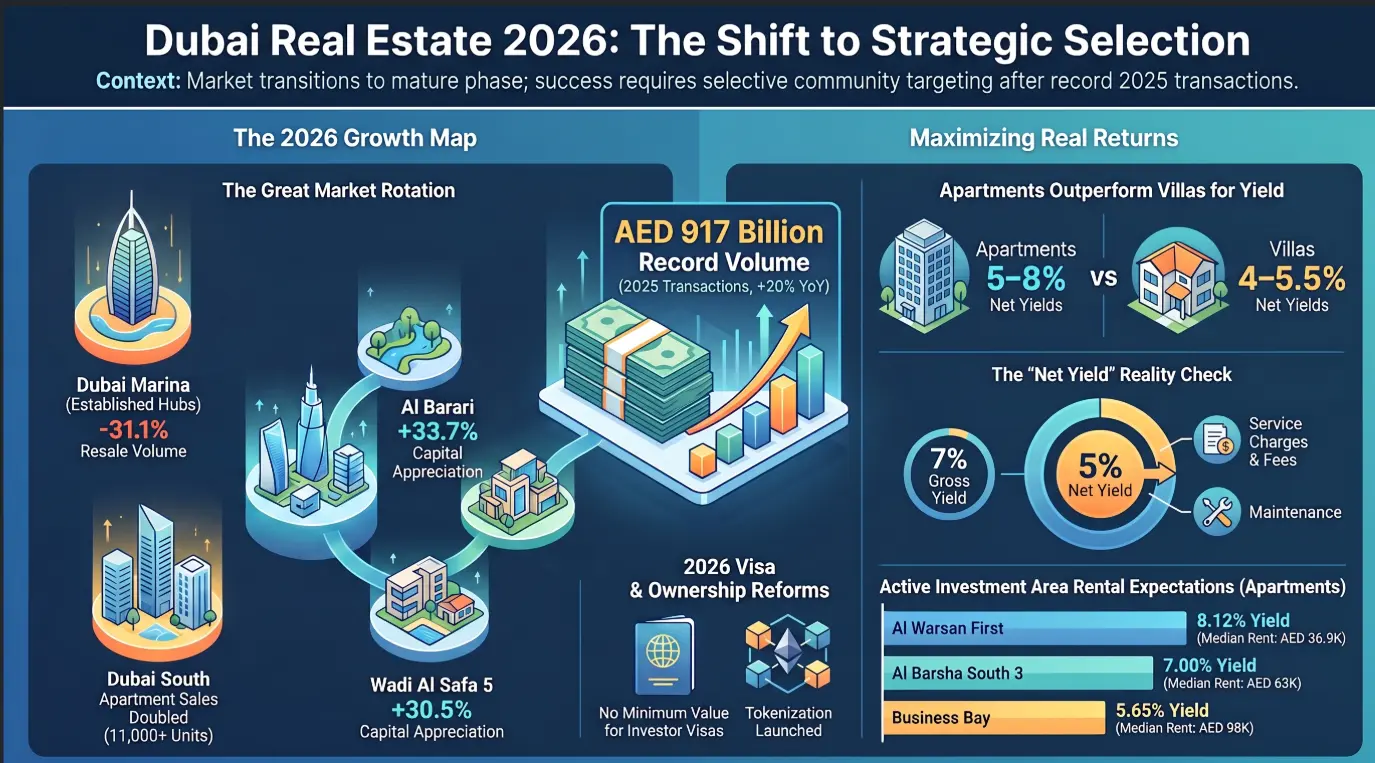
The headline numbers are still strong. Dubai closed 2025 with roughly 270,000 real estate transactions worth AED 917 billion, a record and a 20% jump year on year. (Source: Dubai Land Department, via the UAE Public Debt Management Office )
Underneath that record, the picture is uneven. Off-plan and new-build demand is booming in emerging areas, while resale volumes in several established prime zones are down double digits. This guide walks through what the current data actually shows, what you can realistically earn, and which neighbourhoods are worth a serious look, using registered transaction data from the last 12 months rather than the usual promotional talking points.
Is Dubai Real Estate Still Worth Investing In?
The honest answer is that it depends on what you buy and where. Treating “Dubai” as a single market is the mistake that costs investors money.
The market has matured, not stalled
After five consecutive record years, Dubai’s property market entered a more balanced phase in 2026. The government’s own framing calls it a move from rapid growth to a more mature, sustainable market. Momentum carried into the new year: Q1 2026 transactions rose 31% to AED 252 billion, according to the Dubai Land Department.
At the same time, analysts have flagged a large delivery pipeline through 2025 and 2026. More supply usually means slower price growth, and in some segments, price softening. Fitch has discussed a possible moderate correction in a bearish scenario. This doesn’t mean the market is about to fall over. It means the days of buying almost anything and watching it appreciate are over.
Where demand is still strong
The transaction data from the last 12 months tells a clear story about where buyers are actually putting their money.
In the primary (new-build) apartment market, Dubai South has become the standout. Apartment transaction volume there roughly doubled year on year to 11,173 registered sales, at a moderate median price around AED 1.1 million. Emerging communities in the Wadi Al Safa corridor and Jabal Ali First also saw sharp volume increases.
In the primary villa market, newer master communities are pulling demand. Damac Islands 2 recorded 3,294 sales, Grand Polo Club & Resort jumped 162.8% year on year, and Living Legends villas surged more than 500% off a smaller base.
Where demand is cooling
The resale (secondary) market is where caution is warranted. Several established prime apartment areas saw volumes fall over the same period: Downtown Dubai down 26.9%, Marsa Dubai (Dubai Marina) down 31.1%, and Al Thanyah Fifth down 29.5%. On the villa side, some mature communities also cooled, with Dubai Hills Estate resale volume down 24.2% and Damac Hills 2 primary villa sales dropping sharply.
The takeaway is straightforward. Money is rotating out of some established areas and into newer, more affordable, high-growth communities. If you buy in a cooling area expecting quick appreciation, the data suggests you may be disappointed. If you buy for long-term hold and rental income, established areas can still work, provided the yield stacks up.
The Real Reasons to Invest in Dubai Real Estate
Most guides list ten to fourteen reasons that blur together. Here are the ones that actually move the needle, each tied to something concrete.
No tax on property income or gains
Dubai charges no annual property tax, no capital gains tax, and no tax on residential rental income for individual owners. You do pay a one-time 4% Dubai Land Department transfer fee at purchase, plus registration and agency costs, but there’s no recurring tax drag on your returns. For an investor comparing net income against a market like London or New York, this is a genuine structural advantage, not marketing spin.
Entry prices are still competitive globally
Dubai remains materially cheaper per square foot than most global gateway cities. Prime central apartment prices sit well below London, New York, Singapore, and Hong Kong. That gap is a large part of why international capital keeps arriving: buyers get more space, and more yield, for their money.
Yields that beat most mature markets
Dubai’s average residential rental yields remain higher than most developed-market cities. That combination of lower entry price and higher yield is rare, and it’s the core financial argument for the city. The next section breaks down what those yields actually look like once real costs come out.
The 2026 visa reform
As of April 2026, Dubai removed the previous AED 750,000 minimum property value requirement for sole applicants applying for the standard two-year investor visa, subject to Dubai Land Department approval and eligibility criteria. Longer five-year and ten-year residency options, including the Golden Visa at higher investment thresholds, remain in place. For many overseas buyers, residency is as much the draw as the rental cheque.
A regulated, transparent market
Transactions are overseen by the Dubai Land Department and the Real Estate Regulatory Agency. Every sale and lease is registered, ownership records are digitised, and rental agreements run through the Ejari system. This regulatory backbone is a big reason the market attracts institutional and first-time foreign investors alike.
Fractional ownership is now on the table
In 2026, Dubai launched a government-backed real estate tokenization initiative, allowing fractional ownership of properties. For smaller investors, this lowers the capital needed to get exposure to the market and adds liquidity. It’s early, but it’s one of the few genuinely new developments in how people can invest here, and most competing guides haven’t caught up to it yet.
How Much Can You Earn Renting Property in Dubai?
This is where most articles quote a big gross yield number and stop. That number is not what lands in your bank account. Here’s the fuller picture.
Gross yield versus what you actually keep
Gross rental yield is annual rent divided by purchase price. It ignores costs. Your net yield, the number that matters, comes after service charges, management fees, and vacancy.
Typical costs to subtract:
- Service charges: charged per square foot annually, and they vary widely by building. A high-amenity tower costs far more per square foot than a simple mid-market block.
- Property management: usually around 5% to 10% of annual rent if you don’t self-manage.
- Vacancy: budget for some empty weeks between tenants, even in strong areas.
- Maintenance and minor repairs: ongoing, and higher for older units.
As a rough rule, a gross yield of 7% often translates to something closer to 5% to 5.5% net once these come out. Always ask for the exact service charge per square foot before you buy, because it’s the single biggest swing factor on net return.
Apartments genuinely out-yield villas
The registered rental data from the last 12 months is clear on one point: apartments deliver higher yields than villas in Dubai. Villas win on capital appreciation and family-tenant stability, but if income is your priority, apartments are the stronger play.
Here’s a representative sample from the rental data, showing solid, believable apartment yields in high-volume areas rather than statistical outliers:
Apartment rental yields in active areas
| Area | Median annual rent | Rental yield |
|---|---|---|
| Al Warsan First | AED 36.9K | 8.12% |
| Al Barsha South 3 | AED 63K | 7.00% |
| Al Barsha South Fourth | AED 66K | 6.52% |
| Business Bay | AED 98K | 5.65% |
| Nadd Hessa | AED 53K | 5.58% |
| Marsa Dubai (Dubai Marina) | AED 122K | 4.69% |
Source: DXB Interact, based on registered rental contracts
Villa rental yields in active areas
| Area | Median annual rent | Rental yield |
|---|---|---|
| Town Square | AED 150K | 5.22% |
| Damac Hills 2 | AED 93.5K | 5.19% |
| Villanova | AED 160K | 5.04% |
| Arabian Ranches 3 | AED 175K | 4.93% |
| Al Furjan | AED 216.8K | 4.36% |
| Dubai Hills Estate | AED 300K | 3.27% |
Source: DXB Interact, based on registered rental contracts
A note on the “too good to be true” yields
You’ll see some areas in raw market data showing eye-watering yields, like villa figures above 28% or apartment yields above 14%. Ignore these as headline numbers. They’re distorted by low transaction counts and unusual price-to-rent mixes in specific pockets, and DXB Interact itself cautions that yield should be read alongside liquidity and price movement. A realistic, repeatable Dubai yield sits in the 5% to 8% range for apartments and roughly 4% to 5.5% for villas. Anyone promising you 12%-plus as a reliable return is selling, not advising.
Which Dubai Neighbourhoods Have the Best Investment Returns?
There’s no single “best” area. The right one depends on whether you’re chasing income, growth, or a balance of both. Here’s how the last 12 months of registered transactions break down.
Best areas for capital appreciation
These communities saw the strongest price growth over the period. Note that appreciation figures can be affected by which properties happened to sell, so treat them as direction, not a guarantee.
| Area | Capital appreciation | Median price/sqft |
|---|---|---|
| Al Barari | 33.7% | AED 3,468 |
| Emirates Hills | 30.8% | AED 3,022 |
| Wadi Al Safa 5 | 30.5% | AED 1,158 |
| Green Community | 24.1% | AED 757 |
| Jumeirah Golf Estates | 23.9% | AED 2,387 |
| Mudon | 21.7% | AED 1,638 |
| Palm Jumeirah | 18.1% | AED 4,935 |
| Jumeirah Village Circle | 18.1% | AED 1,434 |
Source: DXB Interact
Best areas for balanced returns
If you want a mix of respectable yield, real transaction volume, and appreciation, a few areas stand out when you read the tables together rather than in isolation.
Wadi Al Safa 5 combines strong appreciation (30.5%) with a relatively accessible median price per square foot, which is why it keeps appearing across the growth rankings. Jumeirah Village Circle pairs solid appreciation (18.1%) with high rental liquidity and mid-range pricing, making it a reliable all-rounder for first-time investors. Business Bay offers central location, deep rental demand, and a mid-5% yield, though its resale volume has softened, so entry timing matters.
High-volume, high-liquidity areas
Liquidity matters because it affects how easily you can exit. These were among the most actively traded areas, meaning more buyers and tenants and less risk of being stuck:
- Dubai South (primary apartments): 11,173 sales, the clear volume leader
- Al Barsha South Fourth: consistently high sales and rental volume
- Business Bay: high transaction value and rental demand
- Jumeirah Village Circle: strong rental and resale activity
Areas to approach with caution
Not a “never buy” list, but places where the recent trend is negative and you’d want a clear reason and a long horizon:
- Downtown Dubai apartments: resale volume down 26.9%
- Marsa Dubai (Dubai Marina) apartments: down 31.1%
- Al Thanyah Fifth apartments: down 29.5%
- Damac Hills 2 primary villas: sharp decline, signalling cooling appetite in that community
Off-Plan Versus Ready Property in 2026
The data reveals a genuine split in the market, and it should shape your strategy.
The case for off-plan
Primary (off-plan and new-build) volumes are where the growth is. Dubai South’s near-doubling of apartment sales is an off-plan story. Off-plan typically offers lower entry prices, staged payment plans, and post-handover payment options that spread the cost. In a rising area, you can see appreciation before you’ve even paid in full.
The case for ready property
A finished property generates rent from day one and carries no construction risk. With resale prices softening in some established areas, patient buyers may find better negotiating room on ready units than they’ve had in years. You can also inspect exactly what you’re buying.
How to choose
If you want immediate income and lower risk, buy ready. If you want maximum upside and can tolerate a delivery timeline plus some construction risk, off-plan in a high-growth area has the stronger data behind it right now. Just buy off-plan through an established developer, because delivery delays are the most common way off-plan investments disappoint.
What Could Actually Go Wrong
A guide that only lists upsides isn’t a guide, it’s an advert. Here are the real risks.
Oversupply and price softening
The large delivery pipeline through 2026 is the biggest macro risk. More units competing for the same tenants can pressure both rents and prices, especially in areas building aggressively. This is why community selection matters more now than it did two years ago.
Buying into a cooling area
As the data shows, several established areas are seeing falling volumes. Buying purely on a famous name, without checking the recent trend, is how people end up holding an underperforming asset.
Service charges eating your yield
High service charges can quietly turn a good-looking gross yield into a mediocre net one. This is the single most overlooked cost. Get the exact figure in writing before committing.
Off-plan delays
Construction timelines slip. A delayed handover pushes back your rental income and ties up capital. Sticking to reputable developers with a delivery track record is the main defence.
Currency exposure
For overseas investors, the dirham’s peg to the US dollar means your returns move with the dollar against your home currency. That can help or hurt depending on where you’re based.
How to Buy Property in Dubai
The process is more streamlined than most first-time buyers expect.
The steps
- Define your goal. Income, appreciation, residency, or personal use. This dictates area and property type.
- Get financing sorted. Cash, or a mortgage. Non-residents can borrow but typically need a larger deposit than residents.
- Choose a freehold area. Foreigners can own outright in designated freehold zones, which include most of the popular investment communities.
- Reserve and sign. A reservation agreement and deposit lock in the property, followed by a sale agreement.
- Transfer at the DLD. Ownership is formally transferred and registered with the Dubai Land Department, and you receive the title deed.
The real cost of buying
Budget beyond the sticker price. Expect the 4% DLD transfer fee, an agency commission (commonly around 2%), plus registration and admin charges. For a mortgage, add valuation and arrangement fees. All in, transaction costs typically land in the region of 6% to 8% of the purchase price.
Who Should Consider Participating Right Now?
Different buyers should point their capital at different parts of the market.
The income seeker
You want steady rental cash flow. Focus on higher-yielding apartments in high-liquidity areas like Al Barsha South Fourth, Business Bay, or Jumeirah Village Circle. Prioritise net yield after service charges over headline gross figures.
The growth seeker
You want capital appreciation and can hold for years. Look at communities with strong recent price growth and reasonable entry points, such as the Wadi Al Safa corridor, or established prestige areas like Jumeirah Golf Estates if budget allows.
The end-user
You’ll live in it. Prioritise lifestyle, commute, schools, and community quality over pure numbers, but still check that you’re not buying into a sharply cooling area.
The residency seeker
Your main goal is a UAE visa. Since April 2026, the entry point for the two-year investor visa is more accessible, and property from AED 2 million opens the ten-year Golden Visa route. Match your purchase to the residency tier you’re targeting.
Frequently Asked Questions
Is Dubai real estate still worth investing in?
Yes, for most investors with a medium to long-term horizon, but selectively. The 2026 market rewards careful area and property-type selection rather than buying anything and expecting it to rise. Off-plan in high-growth communities and well-priced apartments for rental income both have strong data behind them; some established resale markets are cooling.
How much can I earn renting out property in Dubai?
Realistically, expect a net rental yield of around 5% to 8% for apartments and roughly 4% to 5.5% for villas, after service charges, management fees, and vacancy. Apartments generally out-yield villas. Be sceptical of any promised yield above 10% as a reliable, repeatable return.
Which areas have the best investment returns?
It depends on your goal. For appreciation, communities in the Wadi Al Safa corridor, Jumeirah Golf Estates, and Al Barari led recent price growth. For rental income, Al Barsha South Fourth, Business Bay, and Jumeirah Village Circle offer a strong mix of yield and liquidity. For a balance, Jumeirah Village Circle and Wadi Al Safa 5 read well across the tables.
Is Dubai’s property market in a bubble?
Prices have risen for five years and a large supply pipeline could cause a moderate correction in some segments, which some analysts have flagged. That’s a reason for careful selection, not blanket avoidance. Strong population growth and sustained transaction volumes continue to support underlying demand.
Can foreigners buy property in Dubai?
Yes. Foreigners can own property outright in designated freehold areas, which cover most popular investment communities. Ownership is registered and protected by the Dubai Land Department.
What’s the minimum I need to invest?
Entry points vary widely by area. Affordable apartment communities start well below AED 1 million, while prime villas run into the millions. Fractional ownership through the 2026 tokenization initiative lowers the entry barrier further for smaller investors.
Disclaimer: This article is for general information and does not constitute financial or investment advice. Property values and rental yields can go down as well as up. Transaction and market data is drawn from registered figures via DXB Interact (http://dxbinteract.com/best-areas-invest-dubai-real-estate-data) and the Dubai Land Department. Always do your own due diligence and consider speaking to a licensed advisor before investing.
Share this article!


Recent News
How to Compare Trading Platforms When You Are Based in the Gulf: Costs, Regulation and Access to UK and US Markets

How to check your credit score in the UAE
How Many Free Zones in Dubai? and Why It Barely Matters
Featured
No reviews found.
No reviews found.



No reviews found.
No reviews found.