Low Spread Forex Brokers: Why and When They Save You Money
 By
Sam Reid
By
Sam Reid

In forex trading, every pip counts, and the spread is the one cost that touches every single trade you make. Brokers advertise their platforms, bonuses, and commission-free accounts, but the spread takes a cut the moment a position opens. The catch that most guides skip: the lowest spread is not automatically the cheapest way to trade, and this article shows you when a tight spread genuinely saves money and when it does not.
Recent 2026 data puts the industry average EUR/USD spread at roughly 0.88 pips, while the most competitive raw accounts run between 0.0 and 0.2 pips during peak hours. That gap looks small on a single trade. Across hundreds of trades, it decides whether a strategy is profitable.
What a Spread Is
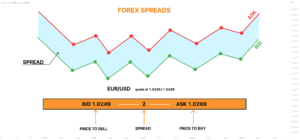
A spread is the difference between the bid (sell) price and the ask (buy) price of a currency pair. It is one of the main ways brokers earn revenue, and for you it is an unavoidable entry cost. Every position opens slightly in the red, by exactly the size of the spread.
Say EUR/USD shows a bid of 1.1000 and an ask of 1.1002. The spread is 2 pips. A trader who buys at 1.1002 needs the price to climb past that level just to reach break-even. The wider the spread, the further the market has to move in your favour before you make a cent, which is why tight spreads matter most for short-term strategies like scalping, where trades target only a few pips.
Why the Spread Matters More Than It Looks
Spreads directly reduce profitability, and for anyone who trades often, the costs stack up fast. Trading one standard lot on EUR/USD at a 2-pip spread costs about 20 dollars per trade. Across 100 trades in a month, that is 2,000 dollars gone to spreads alone.
Run the same 100 trades at a 0.5-pip spread and the cost drops to around 500 dollars, a saving of 1,500 dollars for the same activity. Independent 2026 testing makes the point starkly: a trader executing 20 standard lots of EUR/USD a month for a year pays roughly 20,000 dollars in spreads at 1.0 pip, versus around 1,680 dollars in commission on a 0.0-pip raw account, a difference of more than 18,000 dollars. Far from a rounding error, the spread is one of the largest controllable costs you have.
Fixed Versus Variable Spreads
Brokers offer spreads in two forms, and each suits a different style of trading.
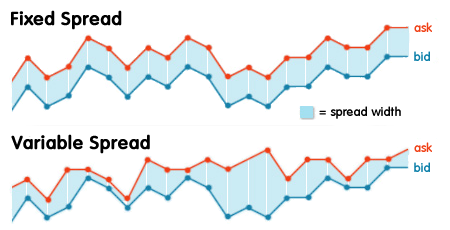
Fixed spreads stay the same in normal and volatile conditions, giving you predictable costs. They suit swing traders and anyone who values knowing the cost in advance.
Variable spreads move with market liquidity and volatility. They tighten during high-activity sessions and can widen sharply during quiet periods or uncertainty. They favour traders who operate during high-volume hours and want the lowest average entry cost.
Account Types, and the All-In Cost That Decides It
Most brokers offer two account structures, and comparing them on spread alone is the mistake that trips up new traders.
| Account type | EUR/USD spread (2026) | Commission |
|---|---|---|
| Standard | Around 1.0 to 1.8 pips | None (cost built into the spread) |
| Raw / ECN | 0.0 to 0.2 pips during peak hours | Roughly $3 to $7 per lot round-trip |
The number that matters is the all-in cost: spread plus commission, not the spread on its own. A raw account at 0.1 pips plus a 3.50 dollar commission works out to roughly 4.50 dollars per lot on EUR/USD. A standard account at 1.0 pip costs about 10 dollars per lot. On that comparison the raw account wins clearly.
The crossover point most traders miss
The raw account is not always cheaper, and this is the detail that decides which account you should pick. Because a raw account charges commission on every trade, its advantage only appears once you trade enough volume for the tighter spread to outweigh that fixed commission. Independent 2026 analysis puts the crossover at roughly 3 to 5 standard lots per day for major pairs.
Below that level, the commission overhead on a raw account can cost you more than a slightly wider commission-free spread would. A lower-volume trader who values simplicity may genuinely be better off on a 0.6-pip commission-free account than a 0.0-pip account with a 7-dollar round-trip commission. Work out your own typical volume before assuming raw is the answer.
Spread Costs in Practice
A worked example makes the trade-off concrete. Trade GBP/USD on a standard account at a 2-pip spread, and a single standard lot costs about 20 dollars. Over 100 trades, that is 2,000 dollars.
Switch to a raw account where the spread is 0.5 pips and the commission is 7 dollars per round trip, and each trade costs roughly 12 dollars all in. Over 100 trades, that is 1,200 dollars. The account structure alone changed your monthly cost by 800 dollars, which is why matching the account to your trading frequency matters as much as finding a low headline spread.
When Spreads Widen
Spreads are not constant. They widen when liquidity drops or uncertainty spikes, and a few conditions reliably push them out.
- Major economic releases, such as central-bank rate decisions, inflation data, and employment reports, where spreads can jump to several pips or more.
- Low-liquidity periods, particularly the Asian session and weekends, when fewer participants are trading.
- Geopolitical shocks and unexpected global events that move markets suddenly.
Some brokers hold spreads relatively stable through these moments; others widen them sharply. Knowing how your broker behaves during news is worth testing before you rely on it, and a platform showing live bid and ask prices lets you watch these shifts as they happen.
What Else Affects Your Cost Per Trade
The spread is only one component of the total. To compare brokers fairly, weigh these alongside it.
- Commissions, the per-lot fee charged on raw and ECN accounts.
- Swap rates, the overnight financing charged or paid for holding a position past the end of the trading day.
- Slippage, the gap between the price you expected and the price your order filled at, which widens in fast markets.
- Platform or data fees, which some brokers charge for advanced tools or market data.
The goal is a broker that balances a tight spread with a fair commission, fast and reliable execution, and no surprise fees. A near-zero spread means little if it comes with slow fills or heavy charges elsewhere.
Common Mistakes to Avoid
The first is assuming the lowest possible spread is always the best deal. A broker can advertise near-zero spreads while charging high commissions or executing orders slowly, so the headline number tells you little on its own.
The second is trading during off-hours. Liquidity thins out during the Asian session and at weekends, which widens spreads and makes prices move more erratically. To keep costs down, trade during high-liquidity windows like the London and New York overlap, avoid low-volume periods, and favour brokers with transparent pricing and stable execution.
Why Regulation Still Matters
Low cost is worth nothing if your funds are not safe. Brokers regulated by serious authorities, such as the UK’s FCA or the UAE’s Capital Market Authority (the CMA, formerly the SCA, renamed under a federal decree effective January 2026), must meet strict standards. They are required to segregate client money, provide negative balance protection, and follow clear reporting rules.
Regulation on its own does not guarantee a tight spread, but it adds a layer of trust that a low spread cannot. A well-regulated broker that also offers competitive spreads gives you the strongest overall value, low cost and real protection together.
The Takeaway for Traders
Treat the spread as a core trading cost, because reducing it improves your risk-reward ratio and leaves more room for profit on every position. Just do not stop at the headline number. Compare the all-in cost of spread plus commission, match the account type to how often you trade, and confirm the broker is properly regulated. Get those three right and you are choosing a broker on the numbers that decide your results, rather than the ones in the advert. For more on staying compliant, see our guide on what traders must check before opening an account.
Frequently Asked Questions
What is the main advantage of a low spread in forex?
A low spread reduces the cost of entering and exiting trades, so you reach break-even faster and keep more of each trade’s profit. The benefit is largest for high-frequency and short-term strategies like scalping, where trades target only a few pips.
Is it better to trade with a lower or higher spread?
Lower is generally more cost-efficient, but only when you account for commission. A raw account with a tight spread and a per-lot commission is cheaper at higher volumes, while a commission-free account with a slightly wider spread can be cheaper for lower-volume traders. Compare the all-in cost, not the spread alone.
Can you trade forex without a spread?
Some brokers offer zero-spread accounts, which remove the bid-ask difference but charge a commission per trade instead. The cost still exists, just in a different form, which is why the all-in figure is the one to compare.
How do spreads affect forex trading?
Spreads decide how far the price must move before a trade turns profitable. Wider spreads require more movement to reach break-even and eat into short-term strategies most, while tighter spreads leave more of each move as profit.
What is the average EUR/USD spread in 2026?
The industry average sits around 0.88 pips, though the most competitive raw and ECN accounts run between 0.0 and 0.2 pips during peak liquidity, and standard commission-free accounts typically range from about 1.0 to 1.8 pips.
When do spreads widen the most?
During major news releases like central-bank decisions and employment data, and during low-liquidity periods such as the Asian session and weekends. In these moments spreads can widen from a fraction of a pip to several pips, so timing your trades around high-liquidity hours reduces cost.
Sources
- Compare Broker – Lowest EUR/USD Spread Forex Brokers 2026 (industry average spread, account-type cost comparison, annual cost differences)
- TopBrokers360 – Best ECN Forex Brokers 2026 (raw vs standard account crossover point, session-based spread ranges)
Share this article!


Recent News
How to Compare Trading Platforms When You Are Based in the Gulf: Costs, Regulation and Access to UK and US Markets
How to check your credit score in the UAE
How Many Free Zones in Dubai? and Why It Barely Matters

Featured
No reviews found.
No reviews found.



No reviews found.
No reviews found.