

 By Staff Writer
Nvidia, the undisputed titan of the AI chip industry, just delivered what can only be described as a financial masterpiece in its latest earnings results. Yet, in a twist that has left analysts scratching their heads, Nvidia stock tumbled more than 5% on Thursday, proving that even perfection isn’t always enough to satisfy Wall Street.
The numbers coming out of Nvidia’s headquarters were nothing short of jaw-dropping. The company reported a record $68.1 billion in revenue for its fiscal fourth quarter, a staggering 73% increase from the same period last year.
This performance crushed analyst expectations of $66.21 billion, according to LSEG. Nvidia’s data center unit, which powers the AI revolution with its market-leading chips, accounted for a whopping 91% of total sales, bringing in $62.3 billion, well above the $60.69 billion forecasted by StreetAccount.
And the good news didn’t stop there. Nvidia’s earnings per share came in at $1.62, easily surpassing Wall Street’s predictions.
Looking ahead, the company issued an upbeat forecast for its fiscal first quarter, projecting revenue of $78 billion, plus or minus 2%. That’s significantly higher than analysts’ expectations of $72.6 billion, signaling that the AI boom is far from over.
So, with results like these, why did Nvidia’s stock take a nosedive?
The answer lies not in Nvidia’s performance but in the broader market’s mood. Investors are increasingly concerned about the sustainability of the AI infrastructure boom that has propelled Nvidia to new heights. The debate has shifted from celebrating near-term results to questioning whether the current levels of capital expenditure on AI can be maintained.
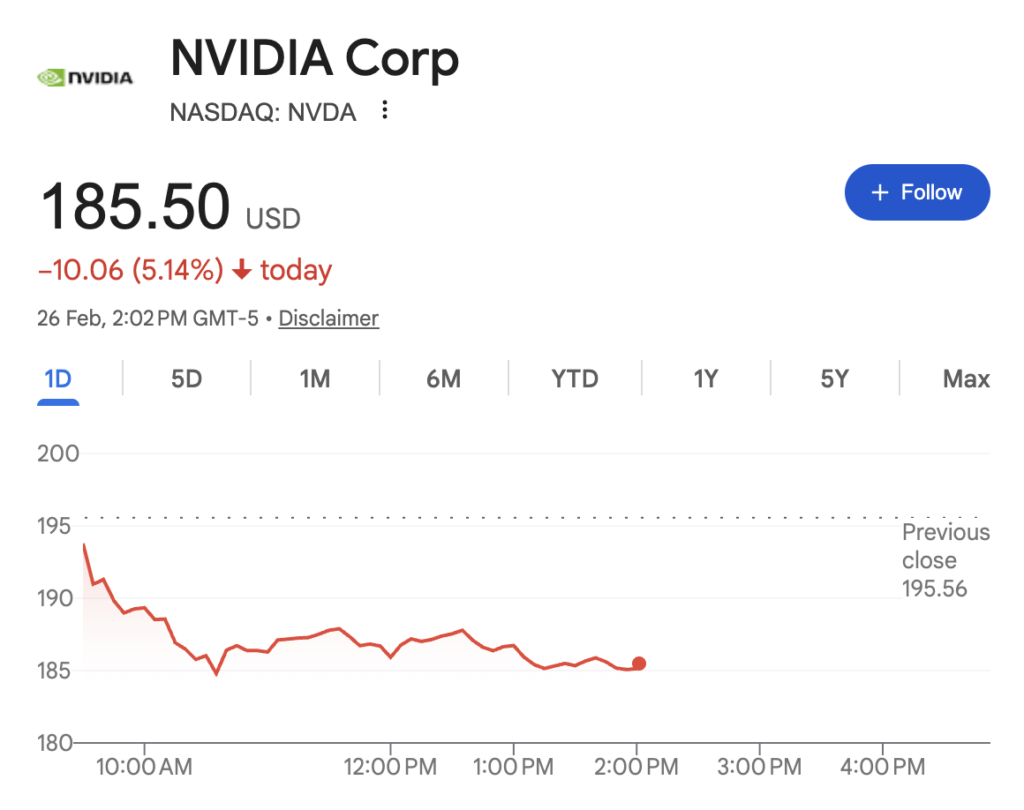
“Even perfect isn’t always enough for Wall Street,” one market watcher quipped, highlighting the paradox of Nvidia’s situation. The company is firing on all cylinders, yet its stock is caught in the crossfire of broader market fears.
One factor contributing to the sell-off is profit-taking. Nvidia’s stock has been on a meteoric rise, and some investors are cashing in their gains, locking in profits while the company is at its peak. This is a common phenomenon when a stock has been on a prolonged winning streak.
But there’s more to the story. Broader market concerns are weighing heavily on tech stocks, and Nvidia is no exception. A new 15% trade tariff and fears of rising interest rates have created a risk-averse environment. Hyperscalers, large-scale cloud providers, saw over $1 trillion wiped from their market caps earlier this month, a stark reminder of the volatility in the tech sector.
Because Nvidia is such a dominant player, it’s particularly sensitive to shifts in market sentiment. When the broader market feels heavy, it tends to drag Nvidia down with it, regardless of the company’s stellar performance.
Nvidia’s fortunes are inextricably tied to the AI industrial revolution, which has driven unprecedented demand for its chips. The company’s data center business, the backbone of its AI operations, has been the primary driver of its revenue boom. But this reliance on AI also makes Nvidia vulnerable to shifts in investor sentiment about the sector.
While the AI boom shows no signs of slowing down, some investors are questioning how long this growth can be sustained. The market is grappling with a fundamental question: Is this a temporary surge, or are we witnessing a long-term transformation in the tech landscape?
Despite the stock’s recent dip, Nvidia’s long-term prospects remain bright. The company’s guidance for the next quarter suggests that demand for its AI chips is still robust, and its ability to consistently outperform expectations underscores its dominance in the market.
For investors, the recent sell-off could be an opportunity to buy into a company that is at the forefront of the AI revolution. However, the broader market’s concerns about tech valuations and capital expenditure will likely continue to create volatility in the near term.
Nvidia’s recent performance is a testament to its leadership in the AI space, but even a company firing on all cylinders isn’t immune to the whims of the market. As the debate around the sustainability of AI spending continues, Nvidia finds itself at the center of a broader conversation about the future of technology and its role in the global economy.