How to Start Forex Trading in Saudi Arabia: The Complete 2026 Guide
 By
Sam Reid
By
Sam Reid
Starting forex trading in Saudi Arabia is legal and increasingly common, but the path is not as simple as the sign-up pages suggest. Two regulators shape what you can do and how you fund it, most reputable brokers serving the Kingdom are licensed abroad rather than locally, and the leverage that makes forex attractive is also what empties most beginner accounts within months. Understanding all of that before you deposit a riyal is the difference between trading and gambling.
The Saudi market is still small in global terms. According to the Bank for International Settlements, Saudi Arabia accounted for roughly 0.1% of daily global forex turnover in 2022. It is growing, though, driven by Vision 2030’s push toward financial diversification, a young and connected population, and easier access to global platforms.
What Forex Trading Involves
Forex trading means buying one currency while selling another, always in pairs such as EUR/USD or USD/SAR. You are betting that one currency will strengthen against the other, and your profit or loss comes from the change in the exchange rate between opening and closing the position.
Most retail forex trading is done through contracts for difference, or CFDs, rather than by physically exchanging currency. A CFD is an agreement to exchange the price difference of an asset between the time you open and close the trade. This matters for two reasons in Saudi Arabia: CFDs are leveraged products, which raises both the risk and the regulatory scrutiny, and their structure raises Sharia-compliance questions covered later in this guide. The same CFD structure underlies other markets too, including the crypto trading brokers some Saudi traders use alongside forex.
The riyal peg, and why it shapes local trading
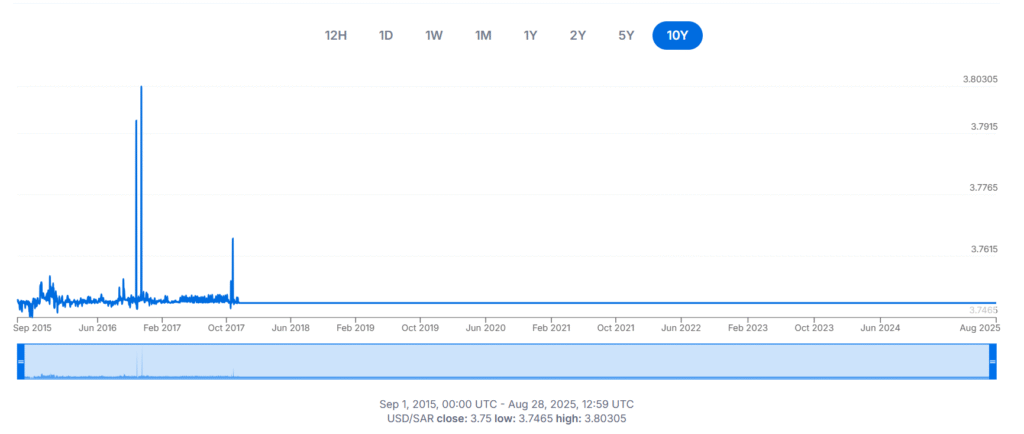
The Saudi riyal has been pegged to the US dollar at 3.75 SAR since 1986. That peg gives the economy stability, and it makes USD/SAR unusually predictable compared with freely floating pairs. For a trader, a fixed peg means very little price movement to profit from, so the pair is thinly traded despite being the local currency. This is why most Saudi traders focus on liquid global pairs like EUR/USD, GBP/USD, and USD/JPY, where daily movement is larger and spreads are tighter.
Who Regulates Forex Trading in Saudi Arabia
This is where most guides oversimplify, and where you need the real picture before choosing a broker or funding an account. Two bodies matter.
The Capital Market Authority
The Capital Market Authority, or CMA, is the Kingdom’s securities regulator. It licenses and supervises financial-services firms operating inside Saudi Arabia. The important detail for a retail trader: the CMA does not currently issue local licences for retail forex or CFD brokers. It regulates the domestic capital market and licensed intermediaries, not offshore retail forex.
The practical consequence is that the well-known brokers serving Saudi clients are not CMA-licensed for retail forex. They operate under foreign regulators instead. That is standard across the region, but it means your protection comes from the broker’s overseas regulator, not from a Saudi authority.
The Saudi Central Bank (SAMA)
The Saudi Central Bank, SAMA, oversees banking, payments, and currency-related transactions. Its role in forex is easy to miss and important: SAMA monitors bank transfers linked to forex trading. Banks apply know-your-customer and source-of-funds checks when you fund a trading account, and they can hold or reject transfers that appear to go to unlicensed currency-trading firms.
In plain terms, the money side is watched even when the trading itself is done offshore. Plan your funding route accordingly, keep records of your deposits and withdrawals, and expect questions from your bank if the amounts are large or frequent.
A point of genuine disagreement
Sources do not fully agree on the legal status of retail forex through offshore brokers. The mainstream position, held by most broker guides and legal summaries, is that individuals may legally trade their own money through a properly regulated international broker, and this is common practice across the Gulf. A minority view argues that retail forex via offshore brokers sits in a grey area because those brokers are not CMA-authorised.
Trading forex as an individual is legal, the CMA does not license the offshore brokers most people use, and the regulatory framework is still developing, with further changes reported in early 2026. If certainty matters for your situation, confirm the current position directly with the CMA and consider professional advice rather than relying on any single article, including this one.
Is Forex Trading Halal in Saudi Arabia?
For many Saudi traders this question matters as much as the regulatory one. Forex trading can be structured to comply with Islamic finance principles, and the central issue is riba, the prohibition on interest.
A standard forex account charges or pays overnight swap fees when you hold a position past the end of the trading day. Those swaps are a form of interest, which makes a standard account problematic under Sharia. The solution is a swap-free account, also called an Islamic account, which removes overnight interest.
What a swap-free label does not cover
A swap-free account solves the interest problem, but it is not blanket permission. Two other Islamic-finance concerns still apply. Gharar, excessive uncertainty, points toward avoiding reckless leverage. Maysir, gambling, points toward trading based on analysis rather than pure speculation. Some brokers also replace swap fees with a fixed administration fee on long-held positions, which can raise its own questions and its own costs.
If Sharia compliance is essential to you, treat the swap-free label as a starting point, compare the total cost including any admin fees, and consult a qualified Islamic-finance scholar about your specific approach rather than assuming the account type settles the matter.
How to Start, Step by Step
The mechanics are straightforward once the regulatory picture is clear.
Learn the fundamentals first
Before any money moves, understand how currency pairs are quoted, what leverage does, and how spreads and commissions eat into profit. Forex is the largest financial market in the world, with daily turnover above seven trillion dollars, and that scale means constant movement you need to read rather than guess at. For Saudi traders, the most active local hours run roughly 3pm to 7pm Arabia Standard Time, when the London and New York sessions overlap and spreads are tightest.
Choose a properly regulated broker
Since no broker holds a CMA retail forex licence, your protection comes from the broker’s overseas regulator. Prioritise brokers supervised by tier-one authorities: the UK’s Financial Conduct Authority, Australia’s ASIC, or the Dubai Financial Services Authority, which is the most regionally relevant. These regulators require segregation of client funds, negative balance protection, and transparent pricing.
Verify the licence rather than trusting a badge on a website. Reputable brokers publish their licence number in the disclosure text at the foot of their homepage, and you can check it on the regulator’s public register. Treat any broker promising guaranteed returns or unusually high leverage as a warning sign.
Open and fund the account
Opening an account is usually an online process requiring proof of identity, a national ID or passport, and proof of address. Funding methods commonly include bank transfer, debit or credit card, and e-wallets. Most accounts are held in USD or EUR rather than riyal. Expect the SAMA-driven bank checks described earlier when you transfer funds, and keep your records clean.
Practise on a demo account
A demo account lets you trade live market conditions with virtual money. This is not a nicety to skip. It forces you to learn the platform, test a strategy, and practise setting stop-loss and take-profit orders before any real capital is at risk. Spend real time here before going live.
Start small when you go live
When you move to real money, start with small position sizes. A cent or micro account lets you trade tiny lots with minimal capital, which is a useful bridge between demo and full exposure. The goal at this stage is to manage risk and build a process, not to chase profit.
What It Costs to Trade
Beginners often focus on the deposit and ignore the running costs, which decide whether an account survives. The main costs are the spread, commission, and any overnight or admin fees.
| Cost | What it is | Who it affects most |
|---|---|---|
| Spread | The gap between the buy and sell price, paid on every trade | Everyone, on every position |
| Commission | A per-trade fee on some account types, often paired with tighter spreads | Active and higher-volume traders |
| Overnight swap | Interest charged or paid for holding a position past end of day | Position and swing traders (removed on swap-free accounts) |
| Admin fee | A fixed charge some brokers apply on swap-free accounts for long holds | Swap-free account holders |
A practical point most guides skip: compare the total cost for your style, not one headline number. An account advertising zero commission but wide spreads can cost more than one with a small commission and tight spreads. Do the arithmetic for the pairs and hold times you trade.
Is 100 dollars enough to begin?
Yes, 100 dollars can be enough to start, particularly with brokers offering micro or cent accounts. It will not generate meaningful income, and it should not be expected to. What it buys is live experience with real money at low risk, which is the point at the beginning. Use small positions, keep leverage modest, and scale only once you have a tested process. Anyone treating 100 dollars as a route to quick wealth is set up to lose it.
The Risks That End Most Accounts
The uncomfortable truth the promotional pages avoid: most retail forex traders lose money. Brokers regulated in strict jurisdictions are required to publish the share of retail accounts that lose, and it is consistently high. Understanding why is the best protection you have.
Leverage cuts both ways
Leverage lets you control a large position with a small deposit. At 1:100, controlling a 10,000 dollar position needs only 100 dollars of margin, and a 1% move against you wipes that margin out entirely. Brokers under strict regulators typically cap retail leverage around 1:30 for exactly this reason. Offshore entities may offer 1:500 or higher, which is not a feature but a faster route to a blown account.
The other common account-killers
Currency pairs move sharply on economic data, central-bank decisions, and geopolitical events, and a single release can erase weeks of gains. Unregulated brokers can widen spreads, delay withdrawals, or vanish with client funds. And the behavioural mistakes end more accounts than the market does: overtrading, trading on emotion, and ignoring stop-losses.
Risk management is not a secondary skill you add later. Stop-loss orders, sensible position sizing, and modest leverage are the foundation of any account that lasts. A trader who protects capital first and chases profit second is already ahead of most beginners.
Tax on Forex Profits in Saudi Arabia
The tax position is genuinely favourable, which is one real advantage of trading from the Kingdom. Saudi Arabia levies no personal income tax on individuals, so profits from forex trading are not subject to personal income tax for a resident individual trading their own money. The personal income tax rate has sat at 0% for years and remains so in 2026.
Two caveats keep this honest. Saudi and GCC nationals are subject to zakat, the 2.5% Islamic wealth levy administered by ZATCA, which applies to eligible assets rather than functioning as an income tax. And anyone trading at a corporate or professional scale, rather than as an individual with personal funds, falls under different rules and should take tax advice. If you have home-country tax obligations elsewhere, those may still apply regardless of the Saudi position.
Vision 2030 and Where the Market Is Heading
Forex interest in the Kingdom tracks Vision 2030, the plan to diversify the economy away from oil and deepen the financial sector. The Financial Sector Development Program within it encourages digital payments, financial inclusion, and fintech, which translates into easier account funding, faster payment rails, and wider access to global platforms for retail traders.
SAMA has also been researching blockchain and a central bank digital currency. That work is still at an early stage, but it signals a regulator preparing for digital finance rather than resisting it. Combined with high smartphone penetration and a young population, the conditions for growth in online trading are strengthening. For anyone starting out, the direction of travel is toward more access and, likely, clearer rules over time.
Frequently Asked Questions
Is forex trading legal in Saudi Arabia?
Trading forex as an individual with your own money is legal. The nuance is that the Capital Market Authority does not license retail forex brokers domestically, so most Saudi residents trade through internationally regulated brokers, while the central bank monitors the bank transfers used to fund those accounts. The framework is still developing, so confirm the current position with the CMA if certainty matters for you.
Do I need a CMA licence to trade forex?
No. The CMA licenses financial-services firms, not individual traders. As an individual trading your own funds through a properly regulated international broker, you do not need a personal licence. You are responsible for choosing a well-regulated broker and meeting any tax obligations.
Is forex trading halal in Saudi Arabia?
It can be, if structured to comply with Sharia. The key requirement is removing riba, so a swap-free or Islamic account that eliminates overnight interest is essential. Beyond that, avoiding excessive leverage and trading on analysis rather than speculation address the concerns of gharar and maysir. For a definitive view on your own approach, consult a qualified Islamic-finance scholar.
Is 100 dollars enough to start forex trading?
Yes, especially with a broker offering micro or cent accounts. It gives you live experience at low risk rather than meaningful income. Use small positions, keep leverage modest, and increase your capital only after you have built and tested a process.
Are forex profits taxed in Saudi Arabia?
Saudi Arabia has no personal income tax, so a resident individual’s forex profits are not subject to personal income tax. Saudi and GCC nationals are subject to zakat on eligible assets, and anyone trading at a corporate scale falls under different rules. Home-country tax obligations may still apply if you have them.
What leverage can Saudi traders use?
It depends on the broker’s regulator. Brokers under strict authorities such as the FCA or ASIC typically cap retail leverage around 1:30. Offshore entities may offer 1:500 or more, which sharply increases the risk of losing your capital. Lower leverage is the safer choice, particularly for beginners.
How do I fund a trading account from Saudi Arabia?
Common methods include bank transfer, debit or credit card, and e-wallets, usually into a USD or EUR account. Expect know-your-customer and source-of-funds checks from your bank, since the central bank monitors transfers linked to forex. Keep clear records of deposits and withdrawals.
Sources
- Bank for International Settlements – Triennial Central Bank Survey of FX turnover (Saudi share of global forex turnover)
- Kingdom of Saudi Arabia – Vision 2030 (financial-sector development goals)
- Capital Market Authority and Saudi Central Bank (SAMA) – regulatory roles in securities, brokers, and payment oversight
Share this article!


Recent News
How to Compare Trading Platforms When You Are Based in the Gulf: Costs, Regulation and Access to UK and US Markets
How to check your credit score in the UAE
How Many Free Zones in Dubai? and Why It Barely Matters
Featured
No reviews found.
No reviews found.



No reviews found.
No reviews found.