How to Calculate Margin in Forex: Formula, Examples, and the Risk Most Traders Miss
 By
Sam Reid
By
Sam Reid

Learning how to calculate margin in forex is one of the first things that separates a disciplined trader from one who blows an account in a bad week. Margin is the capital your broker locks up as collateral when you open a leveraged position, and getting the number wrong is how traders overexpose themselves, hit margin calls, and watch positions close without warning.
The formula itself takes a minute to learn. The part most guides skip, and the part that protects your account, is understanding what margin does and does not tell you about risk. This guide covers both: the exact calculation with worked examples, and the conceptual trap that catches beginners.
What Margin Is
Margin is the amount you must deposit to open a leveraged position. Rather than a fee or a cost, it is a portion of your account balance the broker sets aside as a good-faith deposit while the trade is open, and you get it back when you close the position.
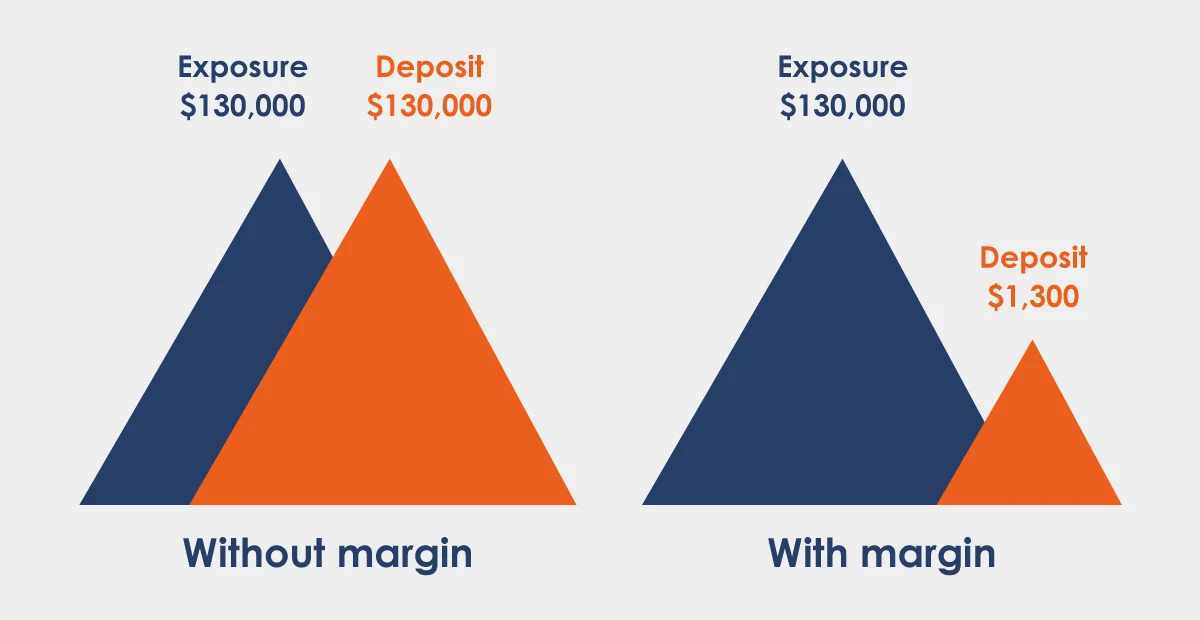
Leverage is what makes margin possible. When you trade with leverage, you do not fund the full value of a position. The broker supplies the rest, and your margin acts as security against the part they are lending you. At 1:100 leverage, you contribute 1% of the trade value and the broker covers the other 99%. A 100,000 dollar position needs 1,000 dollars of margin.
How to Calculate Margin in Forex
The calculation is a single formula that tells you how much of your account will be committed when you open a position.
The margin formula
Margin = (Trade Size × Exchange Rate) ÷ Leverage
The three inputs are the trade size, meaning the number of currency units where one standard lot equals 100,000 units, the current exchange rate of the pair, and the leverage ratio your broker gives you.
Example 1: EUR/USD, one standard lot, 1:100 leverage
With a trade size of 100,000, an exchange rate of 1.1200, and 1:100 leverage:
Margin = (100,000 × 1.1200) ÷ 100 = $1,120
You need 1,120 dollars in your account to open this trade.
Example 2: USD/JPY, one mini lot, 1:50 leverage
With a trade size of 10,000, an exchange rate of 109.50, and 1:50 leverage:
Margin = (10,000 × 109.50) ÷ 50 = 21,900 JPY
Because this result is in yen, a USD account converts it at the current rate. The formula always produces margin in the quote currency of the pair, so a conversion step applies whenever that differs from your account currency.
Margin and Leverage Are Two Sides of the Same Coin
Every leverage ratio corresponds to a margin percentage, because one is simply the inverse of the other. This table shows the relationship for the ratios you will meet most often.
| Leverage | Margin requirement | Margin on a $100,000 position |
|---|---|---|
| 1:30 | 3.33% | $3,333 |
| 1:50 | 2% | $2,000 |
| 1:100 | 1% | $1,000 |
| 1:500 | 0.2% | $200 |
To get the margin percentage from a leverage ratio, divide one by the ratio. 1 divided by 50 is 0.02, or 2%. Higher leverage means a smaller margin requirement, which is why high-leverage accounts can open large positions with very little capital.
The 2026 leverage reality
The leverage available to you depends heavily on where your broker is regulated, and this has tightened in recent years. Brokers under strict regulators such as the UK’s FCA, the EU’s ESMA framework, or Australia’s ASIC cap retail forex leverage at 1:30. Professional accounts may reach 1:100 to 1:200. Offshore entities still advertise 1:500 or more.
So while the 1:500 math is worth understanding, most retail traders under tier-one regulators will be working at 1:30, where a 100,000 dollar position ties up 3,333 dollars rather than 200. Build your expectations around the leverage you can access, not the highest number you have seen advertised.
The Risk Trap: Low Margin Is Not Low Risk
Higher leverage lowers your margin requirement, but it does not change the risk on the trade itself. Your risk is set by your position size and where the market moves, not by how much margin the broker happened to lock up. A one standard lot EUR/USD position carries the same profit and loss per pip whether you opened it at 1:30 or 1:500. The only thing leverage changed is how much of your equity was set aside as collateral.
What high leverage really does is let you open larger positions, or more positions at once, for the same deposit. That is where the danger lies. A trader who sees a 200 dollar margin requirement and thinks the trade is cheap has misunderstood the number. The position is still worth 100,000 dollars, and a 1% move against it is a 1,000 dollar swing regardless of the margin.
Treat margin as a measure of how much capital is committed, not a measure of how much you can lose. Your maximum loss is defined by your position size and your stop-loss, and those are the numbers to manage.
How Margin Requirements Are Set
Brokers set margin requirements based on leverage, account type, and how volatile the instrument is. They are usually shown as a percentage of the position value, and the platform calculates the figure for you when you open a trade.
Requirements are not fixed forever. During periods of high volatility, brokers often raise margin requirements to reduce their exposure, and this frequently happens ahead of major economic announcements or geopolitical events. A position that was comfortable yesterday can require more margin today, which is one more reason to keep a buffer rather than trading at your limit.
Free Margin and Margin Level
Two derived numbers tell you how healthy your account is while trades are open.
Free margin
Free margin is the equity in your account that is not tied up in open positions, meaning the money available to open new trades or to absorb losses on existing ones. The calculation is simply your equity minus your used margin.
On a 5,000 dollar account with 1,200 dollars committed to open trades, your free margin is 3,800 dollars.
Margin level
Margin level is the health check brokers watch most closely. It is calculated as:
Margin Level = (Equity ÷ Used Margin) × 100
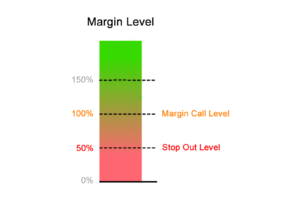
On an account with 10,000 dollars of equity and 8,000 dollars of used margin, the margin level is 125%. A level comfortably above 100% means you have room to support your open positions. As it falls toward 100%, most brokers stop you opening new trades, and further losses move you toward a margin call.
Margin Calls and Stop-Outs
What a margin call is
A margin call happens when your equity falls below the required threshold, usually because open trades are losing money. Most brokers issue the margin call at a 100% margin level. At that point the broker may ask for more funds, block new orders, and warn you that positions are at risk. Watching your account regularly is the simplest way to avoid ever reaching this point.
What a stop-out is
If the margin level keeps falling and you add no funds, the broker starts closing your positions automatically to restore the minimum margin. This is the stop-out, and on most retail brokers it triggers around a 50% margin level, though the exact figure varies. It is an automated liquidation, and it happens whether or not you are watching. Most platforms show a stop-out percentage so you can see how close you are, and keeping well clear of it gives your account room to breathe.
Using a Forex Margin Calculator
A margin calculator estimates the required margin from live market data. You enter your account currency, the currency pair, the trade size, and the leverage ratio, and it returns the exact margin needed. Most brokers provide one inside the platform.
The calculator is convenient, but understanding the manual formula still matters. Knowing how the number is built keeps you aware of how much of your account each trade commits, and lets you sanity-check a figure rather than trusting a tool blindly.
Why Margin Management Matters in Volatile Markets
Forex prices react sharply to global events, interest-rate decisions, and economic data, and during volatile periods those swings can happen within seconds. Without proper margin management, a single sharp move can wipe out your available margin and trigger forced liquidations.
Brokers often respond to volatility by raising margin requirements to cut their exposure. If you have not reviewed your open positions, that change combined with a fast market can drain your free margin quickly. Keeping a buffer of free margin keeps you in control during these periods, and it leaves you room to react to opportunities rather than being pinned near a zero margin level.
The traders who last treat margin as a strategic tool rather than a box to tick. They check margin usage before and after every trade, and they cut position sizes when markets turn uncertain. Even a strong strategy can be undone by poor margin management, because knowing how much each trade commits is what keeps your capital protected when conditions shift.
How to Avoid Margin Calls
The habits that keep an account healthy are simple and consistent:
- Use stop-losses to define your maximum risk on every trade.
- Keep margin usage well below 50% of your account where you can.
- Never commit your full balance to open positions at once.
- Reduce exposure to correlated pairs that can move against you together.
- Watch for scheduled news events that raise volatility.
- Close losing positions before they erode your equity further.
- Add funds when your free margin runs low, rather than waiting for a call.
Managing margin properly keeps your account resilient and reduces the chance of a forced closeout at the worst possible moment.
Frequently Asked Questions
What is the formula for margin in forex?
Margin = (Trade Size × Exchange Rate) ÷ Leverage. This gives the amount of capital locked as collateral to open a position, expressed in the quote currency of the pair.
How do I calculate margin?
Multiply your position size by the current exchange rate, then divide by your leverage. You can also enter the same details into a broker’s margin calculator, but check that the exchange rate and leverage are current.
What is a 1:500 margin in forex?
It means trading at 1:500 leverage, where every 1 dollar of margin controls 500 dollars of the position, so only 0.2% of the trade value is required as margin. Losses are magnified at the same rate as gains, and this level of leverage is generally only available through offshore brokers rather than those under tier-one regulators.
Does lower margin mean lower risk?
No, and this is the most common misunderstanding. Higher leverage lowers the margin requirement but does not change the risk on the trade. Your risk comes from your position size and how far the market moves, not from how much margin was set aside. A larger position is riskier regardless of how little margin it required to open.
What is the difference between a margin call and a stop-out?
A margin call is a warning, usually at a 100% margin level, that your equity has fallen too low and positions are at risk. A stop-out is the automated closing of your positions, usually around a 50% margin level, when losses continue and no funds are added. The margin call comes first; the stop-out is the broker acting to protect the account.
How much margin should I use?
There is no single answer, but keeping used margin well below 50% of your account is a common guideline that leaves a buffer for losses and volatility. Trading close to your full margin gives you no room to absorb a sharp move, which is when forced closeouts happen.
Conclusion
Working the margin formula lets you size positions against the capital you really have, and keep your exposure inside limits you can survive. The formula is quick, but the real skill is understanding what the number means: margin measures how much capital a trade commits, not how much you can lose. Keep that distinction clear, hold a buffer of free margin, and margin becomes a tool that protects your account rather than a surprise that empties it.
Share this article!


Recent News
How to Compare Trading Platforms When You Are Based in the Gulf: Costs, Regulation and Access to UK and US Markets
How to check your credit score in the UAE
How Many Free Zones in Dubai? and Why It Barely Matters

Featured
No reviews found.
No reviews found.



No reviews found.
No reviews found.