How Prop Firms Differ From Retail Brokers
 Sam Reid · Senior Financial Markets Analyst
Staff Writer
Sam Reid · Senior Financial Markets Analyst
Staff Writer  03rd Mar 2026
Opening a trading account feels straightforward until you realize there are fundamentally different types of firms competing for your business. The distinction between prop firms and retail brokers shapes everything from how much capital you can access to what happens when trades go wrong. Most traders stumble into one option without understanding the other, often leaving significant opportunities on the table.
Here’s what matters: retail brokers give you a platform to trade your own money, while prop firms offer access to their capital in exchange for a cut of your profits. That single difference cascades into wildly different fee structures, risk parameters, and earning potential. A trader with $5,000 in personal savings faces a completely different trajectory depending on which path they choose.
Understanding how prop firms differ from retail brokers isn’t just academic. The decision affects your daily trading routine, your psychological relationship with risk, and ultimately how much money ends up in your pocket. Retail brokerage accounts have dominated the conversation for decades, but the prop trading model has exploded in accessibility over the past few years. Firms that once recruited only from elite finance programs now run online evaluations open to anyone willing to prove their skills.
This comparison breaks down the practical differences that actually matter: where the money comes from, how profits get divided, what rules constrain your trading, and which environment suits different types of traders. No fluff about “revolutionizing your trading journey,” just the concrete details you need to make an informed choice.
Core Principles of Prop Trading vs. Retail Brokerage
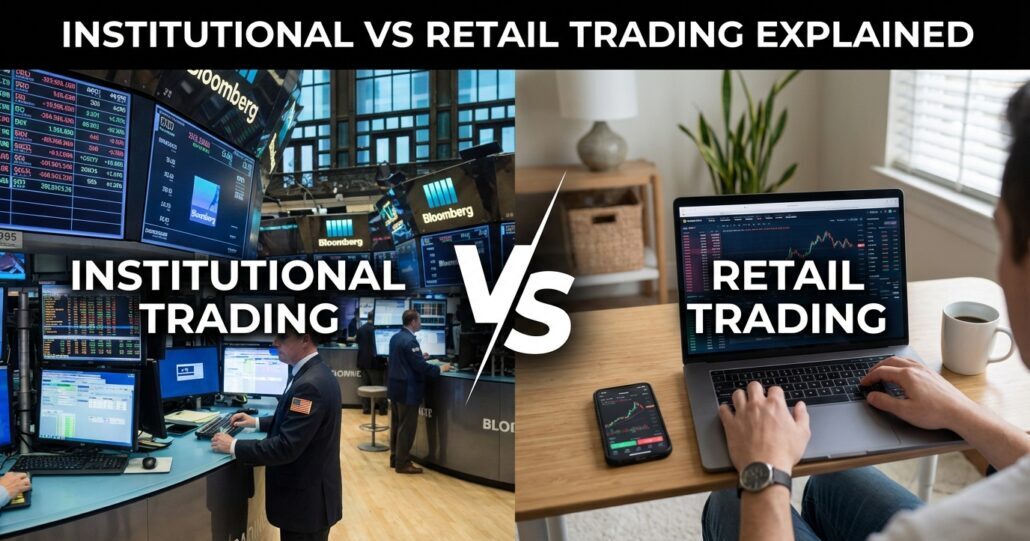
The philosophical gap between these two models runs deeper than most traders initially appreciate. Retail brokers operate as intermediaries, connecting you to markets while earning money regardless of whether you profit or lose. Prop firms have skin in the game alongside you, which fundamentally changes the relationship.
The Source of Capital: Personal Savings vs. Firm Funds
Retail trading requires you to fund your own account. Want to trade with $50,000? You need $50,000. This creates an obvious barrier for skilled traders who lack substantial savings. A 25-year-old with genuine market insight but $3,000 in the bank faces years of slow account building before reaching meaningful position sizes.
Prop firms flip this equation entirely. Through a funded account arrangement, traders access capital pools ranging from $10,000 to $500,000 or more without depositing that amount personally. The firm provides the trading capital after you demonstrate competence through an evaluation process.
This distinction matters enormously for compounding. A 5% monthly return on a $3,000 retail account generates $150. That same skill applied to a $100,000 prop account produces $5,000 in gross profit before splits. The mathematics of account growth favor those who can access larger capital bases earlier in their careers.
Risk Exposure and Liability for Losses
When your retail account drops 40%, that’s your money evaporating. The psychological weight of watching personal savings disappear affects decision-making in ways that compound losses. Many retail traders blow accounts not from lack of skill but from emotional responses to drawdowns in their own capital.
Prop trading shifts the loss liability to the firm once you’re funded. Your maximum downside becomes the evaluation fee you paid, not the full account balance. A trader who fails a $100,000 funded account loses their challenge fee, perhaps $500-1,000, rather than $100,000. This asymmetric risk profile changes how traders approach position sizing and drawdown management.
The Path to a Funded Account
Getting access to prop firm capital isn’t automatic. Firms need assurance that you won’t immediately destroy their money, which means proving yourself before receiving funding.
Evaluation Phases and Performance Milestones
Most prop firms structure their evaluations in phases. A typical two-phase challenge might require hitting an 8% profit target in phase one, then 5% in phase two, all while staying within maximum drawdown limits. These targets must be achieved within specified timeframes, often 30-60 days per phase.
The evaluation process filters out traders who rely on luck or excessive risk. Someone who hits 8% by betting everything on a single trade will likely violate drawdown rules before completing both phases. Firms design these challenges to identify consistent performers, not gamblers who occasionally get lucky.
Specific requirements vary significantly between firms. Some offer single-phase evaluations with higher profit targets. Others extend evaluation periods or adjust drawdown limits. Shopping around matters because the right challenge structure for an aggressive scalper differs from what suits a swing trader holding positions for days.
Instant Access vs. Audition-Based Funding
A newer category of prop firms offers instant funding without evaluation phases. You pay a higher upfront fee and immediately receive a funded account with profit-split arrangements. This appeals to experienced traders confident in their abilities who want to skip the audition process.
The tradeoff involves cost and terms. Instant funding programs typically charge more upfront and may offer less favorable profit splits or stricter risk parameters. Traditional evaluation models cost less initially but require time investment to pass challenges.
Retail brokers sidestep this entirely. Open an account, deposit funds, and start trading immediately. No profit targets, no time limits, no one evaluating your performance. This simplicity appeals to traders who want complete autonomy, though it comes with the capital limitations discussed earlier.
Fee Structures and Profit Sharing Models
Money flows differently through each model, and understanding these mechanics reveals the true cost of trading in each environment.
Spreads and Commissions in Retail Trading
Retail brokers generate revenue through spreads, commissions, or both. Spread-based brokers widen the gap between bid and ask prices, taking their cut from every transaction you make. Commission-based brokers offer tighter spreads but charge explicit per-trade or per-lot fees.
A typical retail forex broker might offer 1-2 pip spreads on major pairs, or raw spreads near 0.1 pips with $7-10 per lot commission. These costs compound quickly for active traders. Someone executing 20 standard lots daily pays $140-200 in commissions alone, plus any spread costs.
Retail traders keep 100% of their profits after covering these transaction costs. No profit splits, no performance fees. If you’re consistently profitable, every dollar of gain belongs to you. This becomes increasingly attractive as account size grows and transaction costs become a smaller percentage of overall returns.
Prop Firm Payout Ratios and Challenge Fees
Prop trading involves different economics. Upfront challenge fees range from $100 for small accounts to $1,000+ for larger funding amounts. These fees cover the firm’s risk of funding unsuccessful traders and generate revenue regardless of outcomes.
Profit splits typically range from 70/30 to 90/10 in the trader’s favor. An 80% split on a $100,000 account means you keep $8,000 from a $10,000 profit month. Some firms offer scaling programs that improve your split percentage as you demonstrate consistent profitability.
The math works differently than retail trading. You’re trading larger capital but keeping a smaller percentage of gains. Whether this benefits you depends on your starting capital and consistency. A trader who would otherwise manage $5,000 personally benefits enormously from an 80% split on $100,000 in profits, even though they’re “losing” 20% to the firm.
Trading Constraints and Risk Management Rules
Freedom versus structure represents one of the starkest contrasts between these trading environments.
Daily Drawdowns and Maximum Loss Limits
Prop firms impose strict risk parameters that retail accounts don’t have. Daily drawdown limits, often 4-5% of account balance, force traders to stop when losses accumulate. Hit this limit and your trading day ends, regardless of market opportunities you see developing.
Maximum drawdown limits, typically 8-12% of initial balance, represent the point of no return. Breach this threshold and you lose the funded account entirely. These rules exist because firms can’t afford traders who might lose 50% of capital before recognizing a strategy isn’t working.
Retail accounts have no such restrictions. You can lose 80% of your account in a single session if you choose. This freedom cuts both ways. It allows experienced traders to manage risk according to their own judgment but also enables destructive behavior during emotional trading sessions.
Inactivity and Consistency Requirements
Many prop firms require regular trading activity. Go two weeks without placing trades and you might lose your funded account. Firms want active traders generating potential profits, not dormant accounts consuming capital allocation.
Consistency rules add another layer. Some firms limit how much of your profit can come from a single trading day. If 40% of monthly gains came from one exceptional session, you might not qualify for payouts. This prevents traders from passing evaluations through one lucky trade rather than repeatable skill.
Retail accounts impose none of these behavioral requirements. Trade daily, weekly, or monthly according to your preference. Take three-month breaks without consequence. This flexibility suits traders with inconsistent schedules or those who prefer waiting for specific market conditions rather than trading regularly.
Technology, Support, and Educational Resources
The platforms and support structures differ meaningfully between models. Retail brokers typically offer proprietary platforms alongside industry standards like MetaTrader 4 and 5. Support focuses on account issues, deposit and withdrawal processing, and basic platform guidance.
Prop firms often provide more sophisticated tools. Real-time risk monitoring dashboards show exactly where you stand relative to drawdown limits. Some firms offer trade journaling integration, performance analytics, and strategy feedback from experienced traders. The educational component tends to be stronger because firms benefit directly from improving trader performance.
However, retail brokers have improved their educational offerings substantially. Many now provide webinars, market analysis, and trading courses. The quality varies dramatically between brokers, from genuinely useful content to thinly veiled marketing.
Platform access differs too. Some prop firms restrict you to specific platforms or brokers, limiting flexibility. Retail accounts let you choose from dozens of brokers and platforms, finding the exact combination that suits your trading style and technical preferences.
Choosing the Right Environment for Your Trading Style
Neither model universally outperforms the other. The right choice depends on your specific situation, capital, experience level, and psychological makeup.
Prop trading makes sense when you have demonstrated skill but limited capital. If you can consistently generate 5-10% monthly returns but only have $2,000 to trade, prop funding multiplies your earning potential dramatically. The structure and rules also benefit traders who struggle with discipline, forcing risk management compliance that they might ignore in personal accounts.
Retail brokerage suits traders with substantial capital who want complete autonomy. If you have $100,000 to trade and a proven track record, keeping 100% of profits beats any split arrangement. Experienced traders who’ve developed their own risk management systems may find prop firm rules unnecessarily restrictive.
Consider your trading frequency and style as well. Scalpers executing dozens of daily trades face significant commission costs in retail accounts but may struggle with prop firm consistency rules. Swing traders holding positions for days encounter fewer transaction costs but might violate prop firm inactivity requirements during slow market periods.
The psychological dimension matters too. Some traders perform better knowing losses come from firm capital rather than personal savings. Others find prop firm rules anxiety-inducing, preferring the freedom to manage risk according to their own judgment.
Start by honestly assessing your current situation. How much capital can you actually risk? What’s your realistic monthly return expectation? Do you need external structure to maintain discipline? The answers point toward which model serves your specific needs. Many successful traders use both simultaneously, maintaining retail accounts for longer-term positions while trading prop capital for more active strategies.
Disclaimer: This content is for educational purposes only and not to be construed as investment advice. Remember that forex and CFD trading involves high risk. Always do your own research and never invest what you cannot afford to lose.