Business Setup in Dubai Mainland: What It Costs and How the Process Works
 By
Sam Reid
By
Sam Reid
The Short Answer
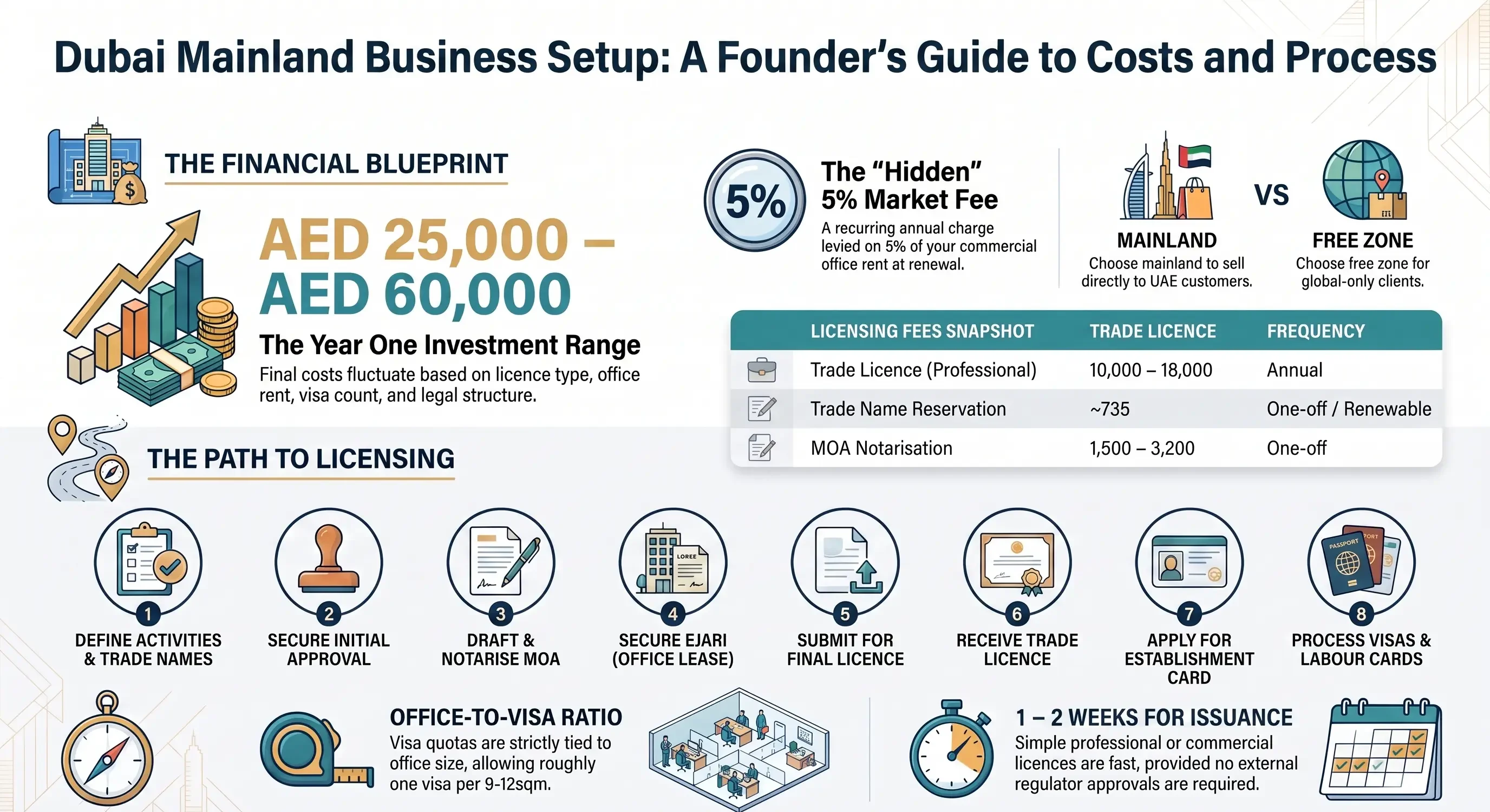
Business setup in Dubai mainland typically costs somewhere between AED 25,000 and AED 60,000 in year one for a small company with one owner visa. If you search for this figure you will find estimates ranging from AED 25,000 to over AED 100,000, and both ends can be correct. The spread comes down to four variables, and once you know them you can work out your own number rather than trusting someone else’s package price.
Those four variables are your licence type, your office, how many visas you need, and whether your legal structure requires a local service agent. Office cost is the biggest one by a wide margin, and it carries a recurring government charge most estimates leave out.
The rest matters less than people think. Registration itself is quick, often a week or two, and government processing fees are modest. A mainland licence lets you sell to customers anywhere in the UAE and bid for government contracts, which is the main reason to choose it over a free zone.
Why Cost Estimates Vary So Widely
Comparing three setup companies will give you three very different numbers for the same business. Four things drive the gap.
Licence type
Dubai’s Department of Economy and Tourism charges different fees by activity category. Professional licences, which cover consultancy, IT, marketing, and design, sit at the lower end. Commercial licences for trading and retail cost more. Industrial licences cost the most. The difference between the cheapest and most expensive category can be AED 10,000 or more before you have paid for anything else.
Office space
This is the variable that moves your total the most. Dubai mainland companies need registered premises, and the range runs from a flexi-desk arrangement at a few thousand dirhams a year to a private office at AED 25,000 to AED 50,000 or more. Two identical companies can differ by AED 40,000 on this line alone.
Visa count
Each residence visa costs several thousand dirhams once you include the medical, Emirates ID, and stamping. A solo founder needs one. A five-person team needs five, plus a bigger office to hold the quota, which compounds the cost.
Legal structure
Certain structures require a local service agent, which adds a recurring annual fee. Others do not. Setup companies quoting the low end are usually pricing a sole establishment with a flexi-desk and one visa. Those quoting the high end are pricing an LLC with a real office and several staff.
What a Mainland Licence Gives You
The practical difference between mainland and free zone comes down to who you can sell to. A mainland company can trade with customers anywhere in the UAE, open a shop, and bid for government contracts. A free zone company selling into the UAE market generally has to go through a distributor, agent, or branch arrangement.
Mainland setups also have no cap on the number of visas beyond what your office space supports, and you can operate from any location in the emirate rather than within a designated zone.
When mainland is the right choice
Choose mainland if your customers are inside the UAE. Retail, restaurants, clinics, salons, construction, local services, and B2B companies selling to UAE businesses all fit here. If you plan to bid for government work, mainland is the only route.
When it is the wrong choice
Setup consultancies rarely say this. If your customers are overseas, a mainland licence costs you more for no benefit. An international consultancy, a software company serving clients abroad, or an online business with a global market will generally pay less and move faster in a free zone, with lighter office requirements. Usually favored by start ups looking to start lean operationally.
Mainland also brings a physical office obligation from the outset in most cases, along with the recurring market fee tied to your rent. If you are testing an idea and want the lowest possible burn, that overhead is hard to justify before you know the business works.
The Cost Breakdown
These are 2026 planning ranges. Your figures will vary by activity, and government fees are periodically revised, so confirm current rates with the Department of Economy and Tourism before budgeting.
Government and licensing fees
| Item | Typical cost (AED) | Frequency |
|---|---|---|
| Initial approval | ~235 | One-off |
| Trade name reservation | ~735 | One-off, renewable |
| Trade licence (professional) | 10,000 – 18,000 | Annual |
| Trade licence (commercial) | 10,000 – 22,000 | Annual |
| Trade licence (industrial) | 15,000 – 25,000+ | Annual |
| MOA notarisation | 1,500 – 3,200 | One-off |
| Chamber of Commerce membership | 620 – 1,200 | Annual |
| Immigration establishment card | 1,000 – 2,000 | One-off |
| External approvals | Varies | Activity-dependent |
Office costs, including the fee people miss
Every Dubai mainland business needs registered premises, and the Department of Economy and Tourism will not issue or renew a trade licence without a valid Ejari certificate linked to an active tenancy contract. Ejari registration itself is inexpensive, roughly AED 220 through a trustee centre or under AED 180 through the Dubai REST app.
The rent is the real cost. A flexi-desk or shared arrangement can start around AED 5,000 a year, while a private office runs from AED 25,000 upwards depending on location and size.
The 5% market fee
This is the charge that catches founders out at renewal. The Department of Economy and Tourism levies a market fee calculated as 5% of your annual commercial rent, rising to 20% for warehouses. It is collected at licence issuance and again at every renewal, and it sits separately from the licence fee itself.
On an office costing AED 60,000 a year, that adds AED 3,000 annually. On a warehouse, the percentage makes the number considerably larger. Any cost estimate that omits this is understating your recurring bill.
Visa costs
An investor or partner visa costs roughly AED 4,000 to AED 7,000 per person, covering the entry permit, medical screening, Emirates ID, and stamping. Employee visas fall in a similar range. Medical insurance is mandatory and adds approximately AED 1,500 to AED 2,000 per person each year.
Visa allocation is tied to office size, with roughly one visa permitted per 9 to 12 square metres of space. If you plan to hire, size your office around the headcount you expect rather than the headcount you have.
What year two costs
Renewal is cheaper than setup, since one-off items like the establishment card and MOA notarisation do not repeat. Expect renewal to run somewhere around 60% to 70% of your first-year figure, made up of the trade licence, Chamber of Commerce membership, the 5% market fee, Ejari renewal, and any local service agent fee. Budget for it from month one, because the bill arrives annually whether or not the business is profitable.
Licence Types and Legal Forms
Choosing your licence
The Ministry of Economy and Tourism recognises six licence categories: industrial, commercial, professional, tourism, agricultural, and crafts. Dubai’s Department of Economy and Tourism offers a broader set including eTrader, instant, SME, and Intelaq licences aimed at specific types of business.
Your business activity determines which licence you need, and there are more than 2,000 activities to choose from. A company can register multiple activities under one licence, though additional activities usually add to the fee.
Choosing your legal form
The main options for a small business are a sole establishment, owned by one individual, and a limited liability company, which offers liability protection and is the standard choice for trading businesses. Civil companies suit professional partnerships, and branch offices work for existing foreign companies expanding into Dubai.
Your legal form has to match your activity, and it affects both your fees and your documentation. An LLC pays more in Chamber of Commerce membership than a sole establishment, for instance.
The local service agent question
This causes more confusion than anything else in Dubai mainland setup.
Since the 2021 commercial companies reform, most mainland activities allow 100% foreign ownership with no Emirati partner holding equity. That part is settled and widely reported.
What is less well reported is that certain structures, particularly civil companies and professional licences held by foreign individuals, can still require a local service agent. The agent holds no shares and no ownership stake. The role is administrative, representing the company with government departments. It does, however, come with an annual fee, and published figures range from around AED 3,000 to AED 25,000 depending on the agent and the arrangement.
The practical takeaway: full foreign ownership and a local service agent requirement are separate questions, and you can face the second while enjoying the first. Confirm which applies to your specific activity and legal form before you budget, because the recurring fee changes your year-two economics.
How the Registration Process Works
The official sequence, as published by the UAE Government, runs as follows.
- Identify your business activity, which determines your licence type and legal form.
- Select your legal form from the available structures.
- Register your trade name with the Department of Economy and Tourism.
- Apply for initial approval, confirming the government has no objection to your business.
- Draft and notarise the Memorandum of Association, or the local service agent agreement where one applies.
- Secure your premises and register the tenancy through Ejari.
- Obtain any additional approvals your activity requires from the relevant authority.
- Submit your documents, pay the fees, and collect your trade licence.
- Apply for your immigration establishment card, then residence visas.
Watch one deadline. Once you receive your payment voucher, you have 30 days to pay for the trade licence. Miss it and the application is cancelled, which means starting the process again.
Trade name rules
Your trade name has to be followed by your legal form acronym, such as LLC or EST. It cannot violate public morals or public order, cannot include the name of any religion or governing authority, cannot use the logos or names of external bodies, and cannot duplicate an existing registration. Submit more than one option to avoid a rejection slowing you down.
Activities needing extra approval
Some sectors require sign-off from a regulator before licensing. Telecommunications activities go through the Telecommunications and Digital Government Regulatory Authority. Financial institutions, exchanges, and insurance require Central Bank approval. Travel agencies with ticketing need the General Civil Aviation Authority. Recruitment agencies go through the Ministry of Human Resources and Emiratisation. Publishing, advertising, and media activities need media regulator approval.
If your activity sits in one of these categories, add several weeks to your timeline and budget for the approval fees.
How long it takes
A straightforward professional or commercial licence with no external approvals can be issued within one to two weeks. Add regulator approvals, attested documents from overseas, or a complex ownership structure and it stretches to four to six weeks or longer.
The federal Bashr platform advertises company establishment in as little as 15 minutes for eligible cases, and Dubai offers an instant licence route. These cover the licence itself. Visas, banking, and any sector approvals still take their own time.
Starting without a full office
The instant licence route helps if cash is tight. It allows you to obtain a trade licence and begin operating before committing to a full office lease, with the Ejari requirement following later. Terms and eligibility vary, so confirm the current rules and the exact period allowed with the Department of Economy and Tourism. Used properly, it removes a significant chunk of first-year capital requirement.
Documents You Will Need
For a company with individual shareholders, expect to provide passport copies for all shareholders and the appointed manager, passport photographs, Emirates ID and visa copies for any UAE residents, your trade name reservation and initial approval certificates, the notarised Memorandum of Association, your Ejari-registered tenancy contract, and any approvals from external authorities relevant to your activity.
Where a shareholder is another company, add the parent company’s incorporation documents, articles of association, and a board resolution approving the new entity. Documents issued outside the UAE need legal translation and attestation, which adds both time and cost.
After Your Licence Is Issued
Registration is the start of your obligations rather than the end of them.
Corporate tax registration with the Federal Tax Authority is mandatory for every UAE company regardless of profit. The deadline depends on your entity type and incorporation date, so check the specific date that applies to you on the FTA portal. Late registration carries an administrative penalty. Taxable income up to AED 375,000 is taxed at 0%, with 9% applying above that threshold.
VAT registration becomes mandatory once taxable turnover passes AED 375,000, with voluntary registration available from AED 187,500. Registration is free, though the ongoing filing obligation carries a bookkeeping cost.
You also need to maintain proper accounting records, renew your trade licence, establishment card, tenancy, and visas annually, and hold any sector-specific permits your activity requires. Opening a corporate bank account is a separate process that begins only after your licence exists, and it is often the slowest step in getting operational.
Frequently Asked Questions
How much does it cost to set up a mainland company in Dubai?
A realistic first-year planning range is AED 25,000 to AED 60,000 for a small company with one owner visa. Trade licence fees run roughly AED 10,000 to AED 25,000 depending on activity, with office rent, visas, and the 5% market fee making up the rest. Larger offices, more visas, or regulated activities push the total considerably higher.
Can a foreigner own 100% of a Dubai mainland company?
In most cases, yes. The 2021 commercial companies reform removed the 51% Emirati ownership requirement for most activities. Liberalisation is activity-specific rather than blanket, and some regulated sectors retain restrictions, so confirm your particular activity.
Do I still need a local service agent?
It depends on your legal form and activity rather than on ownership. Certain structures, notably civil companies and some professional licences held by foreign individuals, can still require one. The agent holds no equity and performs an administrative role, but charges an annual fee. Check the requirement for your specific setup before budgeting.
Do I need a physical office for a mainland licence?
Generally yes. The Department of Economy and Tourism will not issue or renew a trade licence without a valid Ejari certificate tied to an active tenancy. The instant licence route can defer this requirement for an initial period, and a flexi-desk arrangement satisfies it at lower cost than a private office.
What is the 5% market fee?
It is a government charge equal to 5% of your annual commercial rent, or 20% for warehouses, collected by the Department of Economy and Tourism at licence issuance and renewal. It sits separately from your licence fee and recurs annually, which is why it belongs in your budget from the start.
How many visas can I get?
Visa allocation is tied to your office size, at roughly one visa per 9 to 12 square metres. A larger office supports a larger quota. If you plan to hire in year one, factor that into the space you lease rather than discovering the ceiling afterwards.
How long does registration take?
A straightforward licence with no external approvals can be issued within one to two weeks. Regulated activities, overseas attested documents, or complex structures extend this to four to six weeks or more. Add further time for visas and for opening a corporate bank account.
Is mainland or free zone cheaper?
Free zone is usually cheaper to establish and run, largely because office requirements are lighter and packages bundle costs together. Mainland costs more but removes the restriction on selling directly to UAE customers. The right choice follows your customer base rather than the price tag.
A note on the figures in this guide
Every cost here is a planning range rather than a quote. Government fees are revised periodically, licence fees vary by the specific activities you register, and office rent depends entirely on location and size. Regulated activities add approvals, fees, and weeks to the timeline. Two founders registering on the same day with different activities and office arrangements can end up with bills that differ by tens of thousands of dirhams.
Sources
- The Official Platform of the UAE Government – Steps to start a business on the mainland (registration sequence, trade name rules, legal forms, additional approvals, 30-day payment deadline)
- UAE Ministry of Economy and Tourism – Establishing companies (licence categories)
- Invest in Dubai – Mainland companies (Dubai licence types and set-up guidance)
This guide is general information as of mid-2026 and is not legal, tax, or financial advice. Fees, ownership rules, visa quotas, and tax obligations vary by activity and legal form and change over time. Confirm current requirements with the Dubai Department of Economy and Tourism, and check corporate tax and VAT obligations with the Federal Tax Authority before proceeding.
Share this article!


Recent News
How to Compare Trading Platforms When You Are Based in the Gulf: Costs, Regulation and Access to UK and US Markets

How to check your credit score in the UAE

How Many Free Zones in Dubai? and Why It Barely Matters
Featured





No reviews found.
No reviews found.
No reviews found.