Market Order vs Limit Order: What’s the Difference?
 Sam Reid
Staff Writer
Sam Reid
Staff Writer  10th Jan 2026
Market Order vs Limit Order sounds like a small checkbox choice, but it can change what price you get, how fast you get filled, and how much “surprise” you allow into a trade. When testing execution quality across different markets and sessions, one common thing keeps showing up: the order type is often the hidden reason behind slippage, missed entries, and trades that never trigger.
Key Takeaways
- Market orders prioritize speed and usually fill fast, but the final price can move while the order is executing.
- Limit orders prioritize price control, but can remain unfilled if the market never reaches your level.
- Stop orders are triggers. Once activated, they usually behave like market orders, which can create slippage in fast markets.
- Stop limit orders add price control after the trigger, but they can fail to fill during gaps or sharp moves.
- The “best” order type depends on your goal: immediate execution, price control, or risk containment.
Understanding Market Orders and Limit Orders
Before choosing an order button, it helps to decide what you want more:
- Certainty of execution (you get filled, quickly), or
- Certainty of price (you control the worst price you will accept).
That tradeoff is the core difference between limit vs market order. Everything else is a consequence of it: slippage, missed trades, partial fills, and frustration.
In most platforms, you will see a quote with:
- Bid: what buyers are currently willing to pay
- Ask: what sellers are currently willing to accept
- Last: the most recent traded price (useful, but not always the price you will get)
When price is moving quickly, the “last price” can lag what is actually available at bid and ask. That is why order type matters more during volatility.
How Market Orders Work
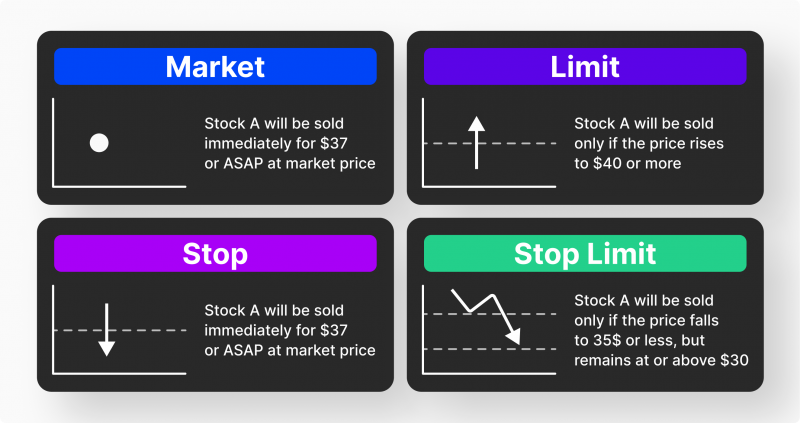
A market order tells the broker: “Execute now at the best available price.” You do not specify a price, so the platform routes you to whatever liquidity is currently available. For liquid, heavily traded assets, the fill can be close to what you see. For thin or volatile assets, the fill can drift. That drift is commonly called slippage.
Fast Fact
Market orders usually execute quickly during normal liquidity, but speed does not guarantee the exact price shown a moment earlier.
Important
Market orders can behave very differently in these situations:
- Right at the open or close of a session
- During major news releases (earnings, CPI, central bank decisions)
- In after-hours or pre-market sessions for stocks
- In low-liquidity pairs or small-cap stocks
- When spreads widen suddenly
Example of a Market Order
Case study: Buying a stock during a fast move (market order)
In this case, a trader wants to buy a stock currently quoted near 150 but is worried about overpaying if the price jumps while the order is executing.
If the trader sends a market order, it will fill immediately at the best available ask. In a volatile move, that might end up being 152 instead of the 150 last seen on screen. This illustrates slippage and “speed over price.”
Tip
If you are practicing execution quality, try placing small market orders in a demo environment during both quiet and busy periods. You will start to see when fills tend to drift and when they stay tight.
What Is a Limit Order?
If you are searching “what is a limit order,” the simplest definition is this: a limit order lets you control price, but it does not promise a fill.
A limit order tells the broker: “Only execute at this price or better.” That means:
- Buy limit order: executes at the limit price or lower
- Sell limit order: executes at the limit price or higher
What Is a Sell Limit Order?
What is a sell limit order in practical terms? It is an instruction to sell only if the market can give you at least your chosen price. If the market never trades there, nothing happens.
How Limit Orders Offer Price Control
Limit orders are popular when you care more about the entry price than getting filled immediately. They are also the main tool for structured entry plans, like buying a pullback level rather than chasing a candle.
Important
Limit orders can still miss. Even if price touches your level, there may be other orders ahead of you, or there may not be enough volume available at that exact price to fill your entire size.
Example of a Limit Order
Case study: Buying a stock during a fast move (limit order)
Same scenario, but the trader chooses price control instead of speed.
Instead, the trader could place a buy limit order at 144, meaning the order will only execute at 144 or better. This avoids any fill above the chosen price, but introduces a real risk: if price never trades down to 144, the order never fills.
Educational material around this example explains the tradeoff clearly. Market orders prioritize certainty of execution. Limit orders prioritize price control. The trader chooses based on which is more important in that moment.
Fast Fact
Limit orders can protect price, but they can also create “opportunity cost” if the market moves away and never returns to your level.
Key Differences Between Market and Limit Orders
Here is the difference between limit and market orders in a way you can apply across assets.
| Feature | Market Order | Limit Order |
|---|---|---|
| Primary goal | Get filled quickly | Control price |
| Execution certainty | High (except halts, illiquidity) | Not guaranteed |
| Price certainty | Not guaranteed | Guaranteed worst price (if filled) |
| Slippage risk | Higher during volatility | Lower on entry, but may miss the trade |
| Best for | Liquid assets, urgent fills | Volatile assets, planned entries/exits |
Tip
If you want to “feel” the difference, run a simple demo test: place a market order and a limit order near the same level during a fast move and compare what happens. It is one of the quickest ways to understand execution mechanics.
Stop and Limit Orders
Many traders mix up stop and limit orders because both involve “a price level.” The difference is what happens after the level is reached.
- Limit order: tries to execute at your price or better. It does not “trigger into something else.”
- Stop order: triggers after price reaches a stop level, then usually becomes a market order.
This matters because a stop order can be triggered at your stop price, but filled somewhere else if price moves quickly.
What Is a Stop Order?
A stop order becomes active only after price hits a trigger level (the stop price). Once triggered, it typically turns into a market order and executes at the best available price.
Common uses:
- Sell stop: placed below current price to attempt to limit downside or protect gains
- Buy stop: placed above current price to enter if price breaks higher
In our execution-focused testing, stops are where traders often get surprised, especially around gaps, news spikes, and thin liquidity. The trigger is precise. The fill may not be.
What Is Stop Loss Limit Order?
What is stop loss limit order in plain terms? It is a stop-based exit that tries to add price control.
Instead of triggering into a market order, it triggers into a limit order. That means you get:
- A stop price that activates the order
- A limit price that sets the worst price you will accept
The tradeoff is important. You reduce the chance of a terrible fill during a sudden drop, but you increase the chance of not getting filled at all if the market gaps past your limit.
Stop Limit Order
A stop limit order uses two prices:
- Stop price: the trigger
- Limit price: the execution boundary after triggering
Example logic (sell side): If price falls to your stop, your limit order becomes active. If price keeps dropping rapidly and never trades at your limit price, the order may remain unfilled.
What Are Price Gaps?
A price gap happens when an asset jumps from one level to another with little or no trading in between. This is common in stocks around earnings and can also happen in other markets during major news.
Stop Orders and Price Gaps
Because stops often become market orders after triggering, a gap can mean the order fills far away from the stop price. The trigger happens, but the next available liquidity might be much lower (or higher for buy stops).
Limit Orders and Price Gaps
Limit orders can sometimes benefit from gaps in a favorable direction. For example, a sell limit set at a specific price might fill at a higher price if the market gaps upward and there is executable liquidity above your limit. The key is that the fill must still be at your price or better.
Understanding Partial Orders in Trading
A partial fill means only part of your order executes. This can happen with both market and limit orders, but it is especially common with limit orders when liquidity is limited at your price.
Why it matters:
- You might get filled on 30% of your intended size and the rest stays pending
- Your average price can differ from what you expected
- Your risk plan can change if you assume you got the full fill
What Is a Good-‘Til-Canceled (GTC) Order?
A GTC order stays active until it is filled or canceled (brokers usually set a maximum duration). GTC is commonly used with limit orders when you are patient and want the market to come to your level.
In practice, GTC becomes powerful when paired with a structured plan, like placing a buy limit at a pullback level and leaving it active rather than watching the chart all day.
Execution Quality and Slippage: Our Practical View
When we focus on execution quality and slippage, here is the mindset we use:
- If a fill must happen now (for example, you are exiting during a fast move), market-style execution can be relevant, but you must accept price uncertainty.
- If entry price discipline matters (for example, your plan is built around a level), limit orders can reduce price drift, but you must accept non-execution risk.
- If you rely on stop triggers, assume gaps and volatility can change your fill, then decide whether stop market or stop limit behavior fits your tolerance.
This is why demo testing is so useful. You can experience the mechanics without real-money pressure.
GCC Notes: Timing, Funding, and Sessions
If you are trading from the UAE or broader GCC, a few practical points help:
- Time zones: US stocks open during evening hours Gulf time for much of the year, so many traders place orders after work. That is exactly when speed and gaps can matter.
- Funding: if you are topping up via local rails (for example bank transfer workflows such as Wio Bank in the UAE, or local options in Saudi like STC Pay depending on the broker), it is worth practicing order types in demo first so your first live deposit is not your first execution lesson.
- After-hours: extended hours can have lower liquidity. Limit orders are often preferred there because market orders can drift more when the book is thin.
Try It in Demo First: A Simple Action Path
If your goal is to learn order behavior, a demo account is the cleanest route. You can test market, limit, and stop-based orders in calm conditions and during volatility, then compare fills.
For example, you can open a demo account with a broker like Exness and place small test orders across different markets. Keep it light. One asset, one session, one goal per test. You are learning mechanics, not chasing results.
FAQs
Which is better, limit or market order?
It depends on what you are optimizing for. Market orders prioritize getting filled quickly. Limit orders prioritize controlling the price. If you care about certainty of entry price, limit orders usually fit the goal better. If you care about certainty of execution, market orders often fit better.
What is the disadvantage of a market order?
The main disadvantage is price uncertainty. During volatility, low liquidity, or wide spreads, the fill can be meaningfully different from the quote you saw. This is the slippage risk, and it is most noticeable around fast moves and thin order books.
When should you use a limit order?
Limit orders are commonly used when price discipline matters more than speed. Examples include buying a pullback to a planned level, avoiding entry during a spike, or setting an exit where you only want to sell at a minimum acceptable price.
How does a market order work?
A market order sends an instruction to execute immediately at the best available price in the market. The broker routes the order to available liquidity at the current bid and ask. The trade typically fills quickly, but the final price can change between clicking and execution, especially in fast markets.
Bottom Line
Market orders and limit orders are not “beginner vs advanced.” They are different tools for different outcomes. If you remember one thing, remember this: market orders buy speed and accept price uncertainty, while limit orders buy price control and accept execution uncertainty.
If you want to learn the mechanics properly, open a demo account, recreate the case study in this article, and watch what happens to the fill when the market accelerates. That single exercise teaches more than memorizing definitions ever will.
Disclaimer: This content is for educational purposes only and not to be construed as investment advice. Remember that forex and CFD trading involves high risk. Always do your own research and never invest what you cannot afford to lose.