Institutional vs Retail Trading Explained
 Sam Reid · Senior Financial Markets Analyst
Staff Writer
Sam Reid · Senior Financial Markets Analyst
Staff Writer  21st Feb 2026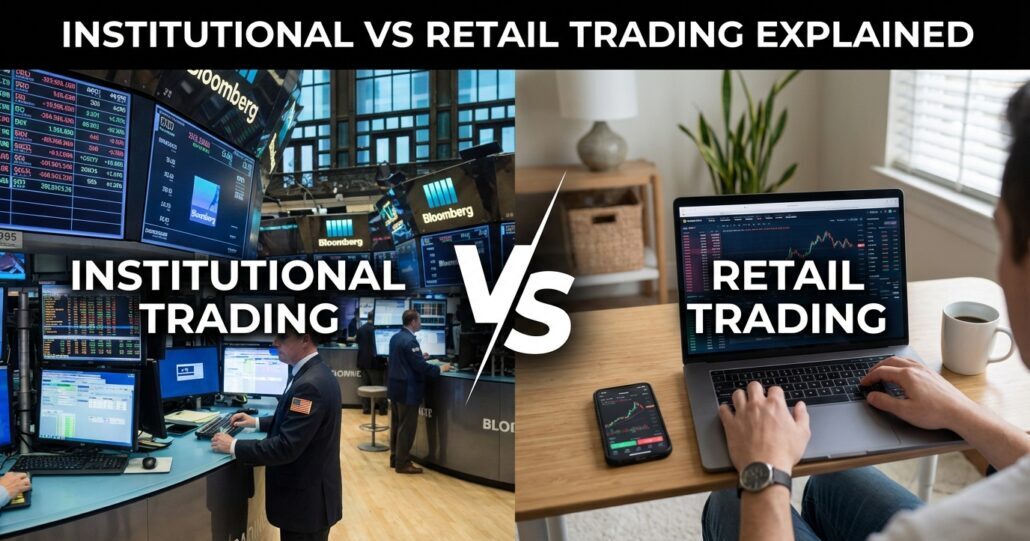
The stock market has a secret most people never learn: you’re not trading against other people like yourself. You’re trading alongside institutions that manage trillions of dollars, employ teams of PhDs, and execute orders using technology that processes millions of calculations per second. Understanding the difference between institutional and retail trading is the foundation of knowing where you actually stand in the financial ecosystem.
When a pension fund decides to buy $500 million worth of Apple stock, they can’t just click “buy” like you do on your brokerage app. Their order would move the entire market against them. Meanwhile, a retail trader with $10,000 can slip in and out of positions without anyone noticing. Both have advantages. Both have significant limitations. The question isn’t which is better. It’s understanding how each operates so you can make smarter decisions with your own capital.
Let me break down how these two worlds differ, where they overlap, and what retail traders can actually learn from the institutional playbook.
Defining the Players: What is Institutional and Retail Trading?
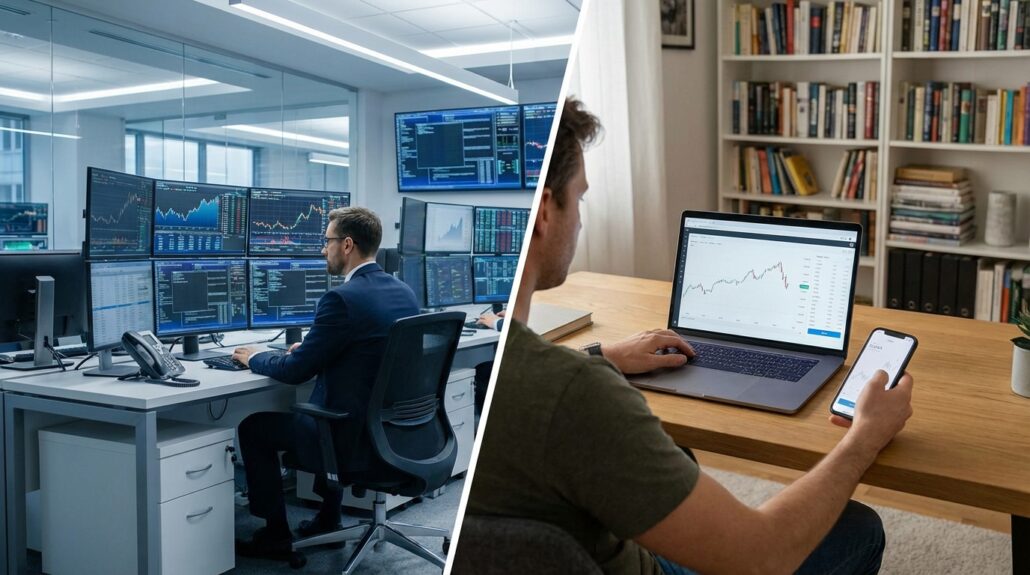
The financial markets host two fundamentally different types of participants. Institutional traders represent large organizations that pool massive amounts of capital from multiple sources. Retail traders are individuals trading their own personal accounts. The distinction matters because these groups operate under completely different constraints, use different tools, and often have opposing objectives.
The Scale and Scope of Institutional Entities
Institutional traders include hedge funds, mutual funds, pension funds, insurance companies, sovereign wealth funds, and investment banks. BlackRock alone manages over $12.5 trillion in assets. Vanguard sits at roughly $10 trillion. When these entities make investment decisions, they’re deploying capital that dwarfs the GDP of most countries.
This scale creates unique challenges. A fund managing $50 billion can’t simply buy a small-cap stock they like. Their position would represent a significant percentage of the company’s total shares outstanding, potentially triggering regulatory filings and moving the stock price dramatically before they finish accumulating. Institutional trading is as much about execution logistics as it is about investment thesis.
These entities also face strict regulatory oversight. They must report large positions, adhere to fiduciary duties, and operate within investment mandates that restrict which assets they can hold. A bond fund can’t suddenly decide to trade crypto, no matter how bullish the portfolio manager feels.
Characteristics of the Individual Retail Trader
Retail traders are individuals using personal brokerage accounts to buy and sell securities. This includes everyone from the retiree managing their IRA to the day trader watching charts for eight hours daily. The retail segment has exploded since 2020, with platforms like Robinhood, Webull, and Fidelity making trading accessible to anyone with a smartphone.
Retail traders typically work with smaller capital bases, ranging from a few hundred dollars to several million for high-net-worth individuals. They face fewer regulatory constraints and can trade almost any asset class without mandate restrictions. A retail trader can own Tesla stock, Bitcoin, gold ETFs, and options on meme stocks simultaneously. No compliance officer will question the portfolio construction.
The tradeoff is access. Retail traders generally see delayed information, pay wider spreads on certain products, and lack the sophisticated tools that institutions take for granted.
Core Mechanics: How Institutional Traders Trade
Understanding how institutional traders actually execute their strategies reveals why markets behave the way they do. These aren’t just bigger versions of retail traders. They operate in an entirely different manner.
Access to High-Frequency Trading and Proprietary Tools
Many institutional players deploy high-frequency trading systems that execute thousands of trades per second. These algorithms analyze market microstructure, identify arbitrage opportunities, and provide liquidity across exchanges. The infrastructure required costs millions annually: co-located servers, direct market access, proprietary data feeds, and teams of quantitative engineers.
Institutions also access trading platforms unavailable to retail participants. Bloomberg terminals cost roughly $27,000 to $31,980 per year per user. Specialized order management systems, risk analytics platforms, and execution algorithms represent additional expenses that only make economic sense at scale.
This technology gap creates information asymmetry. An institutional trader sees order flow, depth of book, and market microstructure data that retail traders simply cannot access through standard platforms.
The Role of Information Symmetry and Research Desks
Major institutions employ armies of analysts covering specific sectors, geographies, and asset classes. Goldman Sachs employs over 400 research analysts globally. These teams build proprietary models, conduct management interviews, and synthesize information that generates investment ideas.
While retail traders can access published research, institutions often receive it first. More importantly, they have the resources to generate original research through alternative data sources: satellite imagery tracking parking lot traffic, credit card transaction data, web scraping for pricing changes, and expert network calls with industry insiders.
This research advantage doesn’t guarantee better returns. Plenty of hedge funds underperform index funds despite their resources. But it does mean institutions operate with a fundamentally different information set than the average retail trader reading news headlines.
Execution Strategies for Massive Capital
Here’s where institutional trading gets genuinely interesting. Moving large amounts of capital without destroying your own returns requires sophisticated execution strategies that most retail traders never consider.
How Hedge Funds Execute Large Trades Without Market Impact
Imagine you manage a fund and want to buy 5 million shares of a mid-cap stock trading 2 million shares daily. If you place a market order, you’d consume multiple days of volume, push the price up dramatically, and pay far more than the current quote. This is called market impact, and minimizing it is an obsession for institutional traders.
The solution involves patience and stealth. Large orders get broken into smaller pieces executed over hours, days, or even weeks. Traders use limit orders at various price levels, participate in auctions, and time their activity to coincide with periods of higher liquidity.
Some institutions employ dedicated execution traders whose sole job is minimizing market impact. Their performance is measured in basis points saved versus a benchmark like the volume-weighted average price.
Utilizing Dark Pools and Block Trading
Dark pools are private exchanges where institutional investors can trade large blocks of shares without displaying their orders publicly. When a pension fund wants to sell 2 million shares of Microsoft, posting that order on a public exchange would signal their intentions to the entire market. Traders would front-run the order, pushing the price down before the fund could execute.
Dark pools solve this by matching buyers and sellers privately. The trade only becomes public after execution. Major dark pools include Liquidnet, ITG Posit, and pools operated by investment banks.
Block trading desks at major brokers also facilitate large transactions. A fund might call Goldman’s block desk and request a bid on 500,000 shares. Goldman provides a price, takes the shares onto their own book, and then works out of the position over time. The fund gets immediate execution while Goldman assumes the market risk.
Algorithmic Slicing and VWAP Execution
Algorithmic execution has become standard for institutional orders. VWAP algorithms slice large orders into smaller pieces and execute them throughout the day, targeting the volume-weighted average price as a benchmark. If a stock typically trades 30% of its volume in the first hour, the algorithm allocates 30% of the order to that period.
Other algorithms include TWAP, which executes evenly over time, and implementation shortfall algorithms that balance speed against market impact. Participation rate algorithms maintain a consistent percentage of market volume.
These tools are increasingly available to sophisticated retail traders through platforms like Interactive Brokers, but most retail participants stick with simple market or limit orders.
Retail Trading Limitations and Advantages
Retail traders face real disadvantages against institutional competition, but they also possess underappreciated advantages that institutions would love to have.
Lower Barriers to Entry and Simplified Platforms
Opening a brokerage account takes minutes. Commission-free trading has eliminated transaction costs for most retail trades. Fractional shares allow investment with any amount. These developments have democratized market access in ways unimaginable twenty years ago.
Modern retail platforms provide charting, screening tools, and educational resources that would have cost thousands annually in previous decades. While not matching institutional infrastructure, the gap has narrowed considerably.
The limitation is execution quality. Retail orders often get routed to market makers who profit from the order flow. Payment for order flow means your “free” trade actually costs something in execution quality, though the amounts are typically small for standard-sized orders.
Agility: The Ability to Enter and Exit Positions Instantly
This is the retail trader’s superpower. With a small account, you can buy or sell immediately without moving markets. You can completely exit a position in seconds if your thesis changes. Institutions managing billions don’t have this luxury.
Retail traders can also invest in small-cap and micro-cap stocks that institutions literally cannot touch. A $100 billion fund cannot meaningfully invest in a company with a $200 million market cap. The position would be either too small to matter or too large to execute.
This agility extends to strategy changes. A retail trader can shift from value investing to momentum trading overnight. An institutional fund must stick to its stated mandate or face investor redemptions and regulatory scrutiny.
Key Differences in Risk Management and Regulation
Institutional traders operate under strict risk management frameworks enforced by compliance departments, prime brokers, and regulators. Position limits, value-at-risk calculations, and stress testing are mandatory. Risk managers have authority to force position reductions regardless of the portfolio manager’s views.
Retail traders face no such external constraints. This freedom cuts both ways. You can concentrate your portfolio in ways institutions cannot, potentially generating outsized returns. You can also blow up your account with excessive leverage or poor position sizing.
Regulation also differs dramatically. Institutions must register with the SEC, file quarterly holdings reports, and comply with rules around insider trading, market manipulation, and best execution. Retail traders face fewer reporting requirements but must still follow basic securities laws.
Bridging the Gap: How Retail Traders Can Follow Smart Money
Understanding institutional behavior creates opportunities for retail traders. You can track 13F filings to see what major funds bought last quarter. You can monitor dark pool activity through services that aggregate this data. You can observe unusual options flow that might signal institutional positioning.
More practically, retail traders can adopt institutional thinking without institutional resources. This means focusing on position sizing, understanding market microstructure, and recognizing when you’re trading against better-informed participants.
The smartest approach combines retail advantages with institutional wisdom. Use your agility to exploit opportunities in smaller names institutions ignore. Apply disciplined risk management even without external enforcement. Recognize that in highly efficient large-cap markets, you’re unlikely to consistently outperform institutional research teams.
Trading successfully means understanding your place in the ecosystem. Institutions move markets and set prices. Retail traders can profit by understanding these dynamics rather than fighting them. The goal isn’t to become an institution. It’s to trade intelligently alongside them.
Disclaimer: This content is for educational purposes only and not to be construed as investment advice. Remember that forex and CFD trading involves high risk. Always do your own research and never invest what you cannot afford to lose.